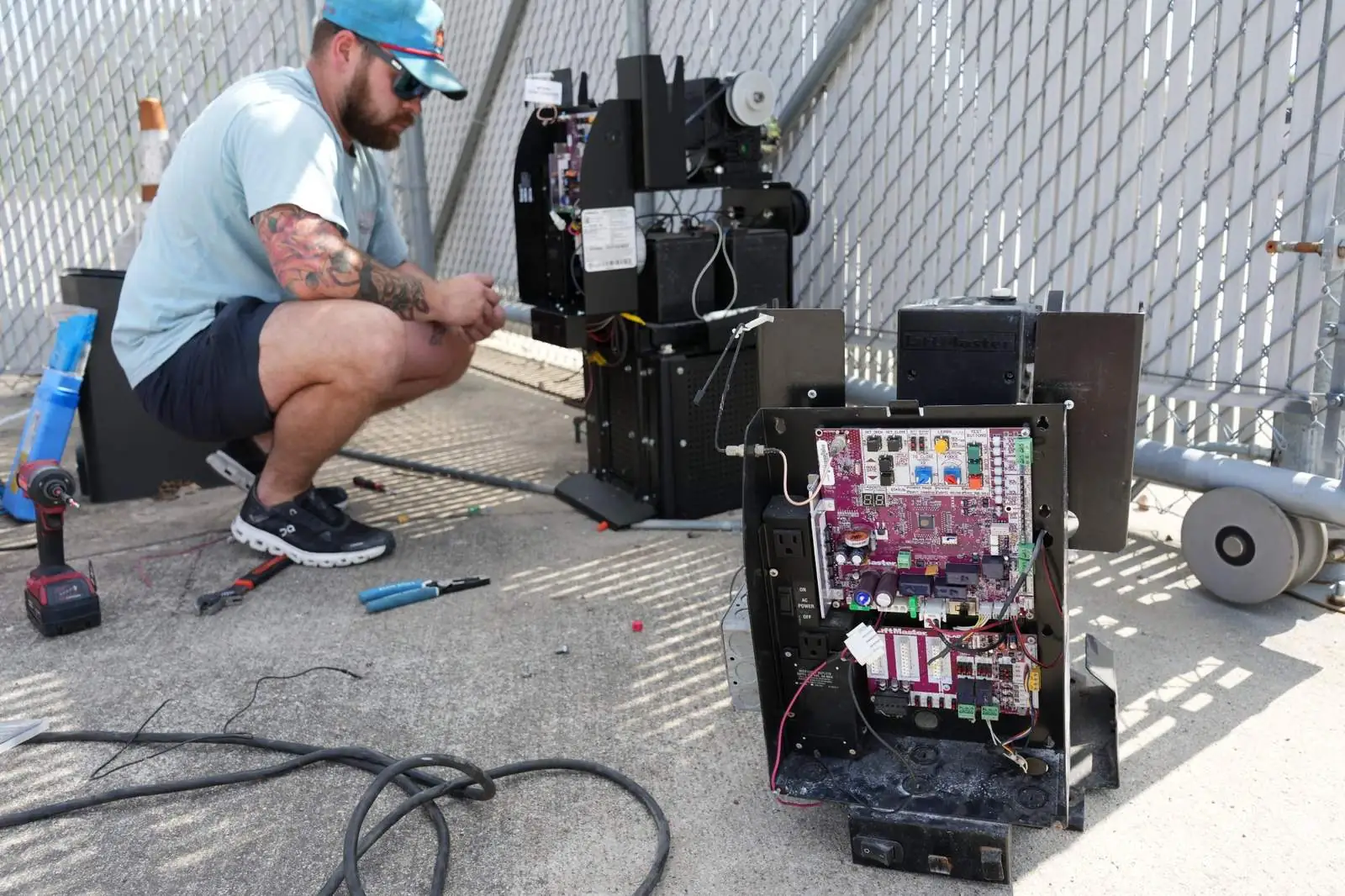
A black steel operator housing sitting in full Houston sun in August reaches internal temperatures far above the air temperature — well past what the electronics inside were designed to sit at all day. Add a battery that has been cooking since May and steel that has expanded a fraction of an inch, and you get the cluster of failures we see every summer.
1. Backup Batteries Die First
This is the single most common summer failure. Sealed lead-acid batteries lose service life roughly in half for every 15°F above their rated temperature, which is why a battery that would go five years in a garage gives you two or three inside a sun-baked control box in Houston.
A dying battery does not fail cleanly. It causes behavior that looks like something much worse: the gate opens slowly, stops halfway, works in the morning and quits by afternoon, or the control box clicks without the gate moving. People replace boards and call for motor quotes when the actual problem is a battery that cannot hold voltage under load.
What to do: know how old yours is. If it is past three years, replace it before summer rather than during. If your operator is in full sun, plan on the short end of the range.
2. Control Boards Cook
Capacitors and relays are the heat-sensitive parts, and they degrade with cumulative exposure rather than failing at a specific temperature. A board that has spent five Houston summers in a black enclosure facing west is on borrowed time regardless of how it looks.
Summer is also peak lightning season here, and a board weakened by heat is far more likely to be finished off by a surge. If your gate died right after a storm, see the troubleshooting checklist — but the underlying cause is often months of thermal stress, not the one strike.
What to do: shade the operator if you can — a simple cover or a shrub positioned to block afternoon sun makes a measurable difference. Make sure the enclosure is sealed but ventilated as designed, and confirm you have surge protection.
3. Solar Systems Underperform in the Heat
Counterintuitive, but true: solar panels lose efficiency as they get hotter, and their batteries are under the same heat stress as any other. A solar gate that worked fine through spring can start browning out in August, especially if the panel was sized with no margin or has accumulated pollen and dust.
What to do: rinse the panel, check that nothing has grown into its sun path, and test the battery under load.
4. Steel Expands
Steel grows with heat, and a 16-foot gate leaf is measurably longer on a 100°F afternoon than on a 40°F morning. It is a small amount, but gate clearances are small too. Gates set with tight gaps in winter can start catching the latch post or scraping in midsummer, and slide gates can bind at the ends of travel.
The related failure: if the gate has also sagged or a post has drifted, summer expansion is what finally pushes it past the point where the operator can complete a cycle. The gate did not break in July — July just used up the last of the margin.
What to do: if the gate started rubbing in summer, do not just turn up the operator force. That masks the problem and defeats the entrapment protection. Have the clearances checked.
5. Lubricants Break Down and Debris Bakes On
Light oils thin out and run off in extreme heat, leaving hinges and rollers dry right when they are working hardest. Meanwhile the mud that packed into a slide gate track during spring storms has dried into concrete-like ridges. Both add friction, and friction is what the operator reads as an obstruction.
What to do: use a lubricant rated for the temperature — a lithium or synthetic grease on hinges and rollers rather than a spray oil — and clear the track before it bakes hard.
Ground Movement Is the Slow One
Summer drought shrinks Houston’s clay soil, and shrinking clay pulls gate posts out of plumb the same way swelling clay pushes them. Then the first big rain in September swells it back. That annual cycle is what walks a shallow-set post out of alignment over a few years, and it is covered in depth in why Houston clay destroys gates.
A Twenty-Minute Pre-Summer Routine
- Check the backup battery’s age; replace anything past three years
- Confirm surge protection is present and intact
- Shade the operator housing from afternoon sun if you can do it without blocking access
- Grease hinges, rollers, and pivots with a heat-appropriate lubricant
- Clear and rinse slide gate tracks before the mud sets
- Rinse solar panels and clear anything growing into their light
- Check gate clearances at the latch post and along the ground
- Test the photo eyes and the manual release
That is most of the spring half of the homeowner maintenance checklist, done in April or May instead of after something breaks.
Why It Matters When It Fails
August is also the front half of hurricane season, and a gate that is already limping is the one that will not open when you need to leave or close when you need to secure the property. If a storm is in the Gulf, the prep checklist takes fifteen minutes — but it assumes the gate is working going in.
Battery, board, or mechanical — we will tell you which
$89 service call, applied to the repair. Same-day service across Houston, The Woodlands, Katy, Spring, Cypress, and surrounding areas. We call back within 30 minutes. More on our gate repair page.