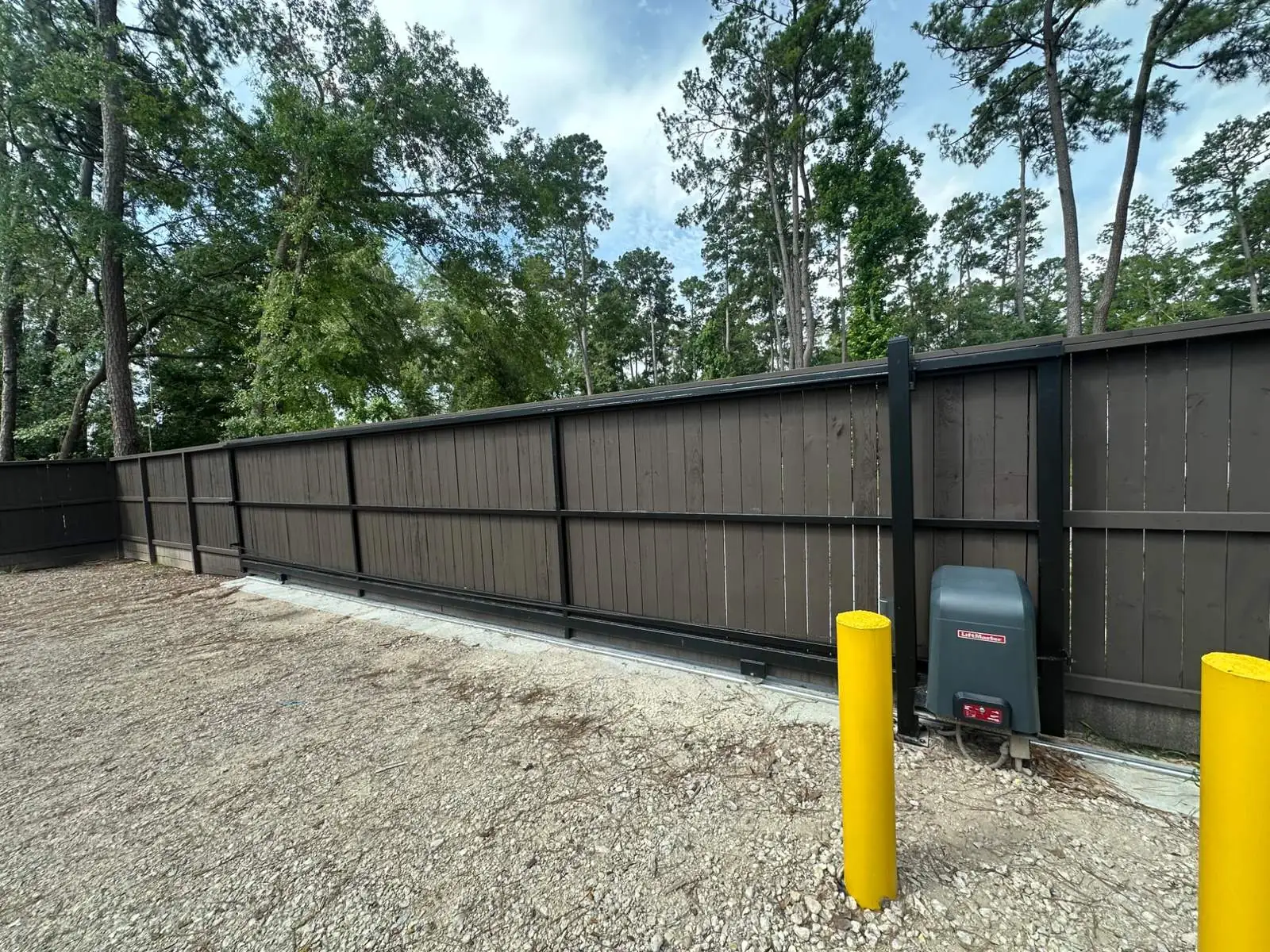
Every week we get the same call from somewhere in Houston: “My gate was fine for two years, now it drags on the driveway and the opener strains.” The homeowner suspects the operator. The operator is innocent. The guilty party is under the fence line — Houston's infamous gumbo clay, and it has been slowly moving the gate posts since the day they were set.
What Gumbo Clay Actually Does
Houston sits on vertisol — expansive clay soil that locals call gumbo. When it rains, the clay absorbs water and swells. During our brutal summer droughts, it dries and shrinks, opening those cracks you see in August lawns. This is not subtle movement: Houston clay can swell and shrink enough to move foundations, crack slabs, and — relevant to us — tilt any post set in it. The soil your gate posts live in physically changes volume with the weather, season after season, forever.
Why Gates Feel It Worse Than Fences
A fence post that tilts half a degree is invisible. A gate post that tilts half a degree moves the far end of a 14-foot leaf more than an inch — suddenly the gate drags, the latch misses, or the leaf gaps at the top. Gates amplify post movement because the leaf is a long lever, and a swing gate post also carries the full gate weight as a rotating cantilever load. The post is fighting both the soil and physics.
Then the second failure begins: the operator keeps pushing a misaligned, dragging gate. Motors strain, gears wear, capacitors cook. We regularly diagnose “failed operators” that are actually healthy units that spent two years fighting a heaved post. Fix the alignment without fixing the footing, and you will be doing it again in eighteen months.
The Footing Spec That Survives Houston
You cannot stop clay from moving. You can build footings deep and heavy enough that the movement happens around them instead of to them. Here is what that means in practice:
- Depth below the active zone: the top couple feet of clay move the most. Footings need to reach well below the surface moisture cycle — for gate posts, that means substantially deeper than the 24 inches typical of fence work
- Diameter and mass: a wide concrete cylinder resists tilting the way a wine cork resists tipping in honey — mass and bearing area matter
- Sized to the gate: a 200-lb single leaf and a 700-lb custom iron dual swing do not get the same footing. Load determines spec
- Drainage matters: water pooling at a post base supercharges the swell cycle. Grade should shed water away from footings
Warning Signs Your Posts Are Moving
- Gate drags on the driveway at one point in its swing — or only in summer, or only after rain
- The latch or magnetic lock misses its catch and needs a lift or shove
- Visible gap change at the top of the gate between seasons
- Operator sounds like it is straining, or reverses mid-travel with nothing in the path
- Hairline cracks in the concrete collar around a post
Can a Heaved Post Be Fixed?
Usually, yes — and usually without replacing the gate. Depending on severity, the fix ranges from a hinge-side realignment (quick), to excavating and re-setting the post in a proper new footing (a day's work), to adding a footing where a builder-grade installation never had a real one. What we do not do is bend hinges to chase a moving post — that is the band-aid other companies apply, and it buys months, not years.
If your gate drags, gaps, or strains seasonally, that pattern is the clay talking. Our $89 service call includes a full alignment and footing assessment — we will tell you whether you have an adjustment problem or a foundation problem, and exactly what fixing it for good costs.
$89 assessment — we find out if it's the post or the operator
We call back within 30 minutes. Same-day service available across Houston, The Woodlands, Katy, Spring, and surrounding areas.