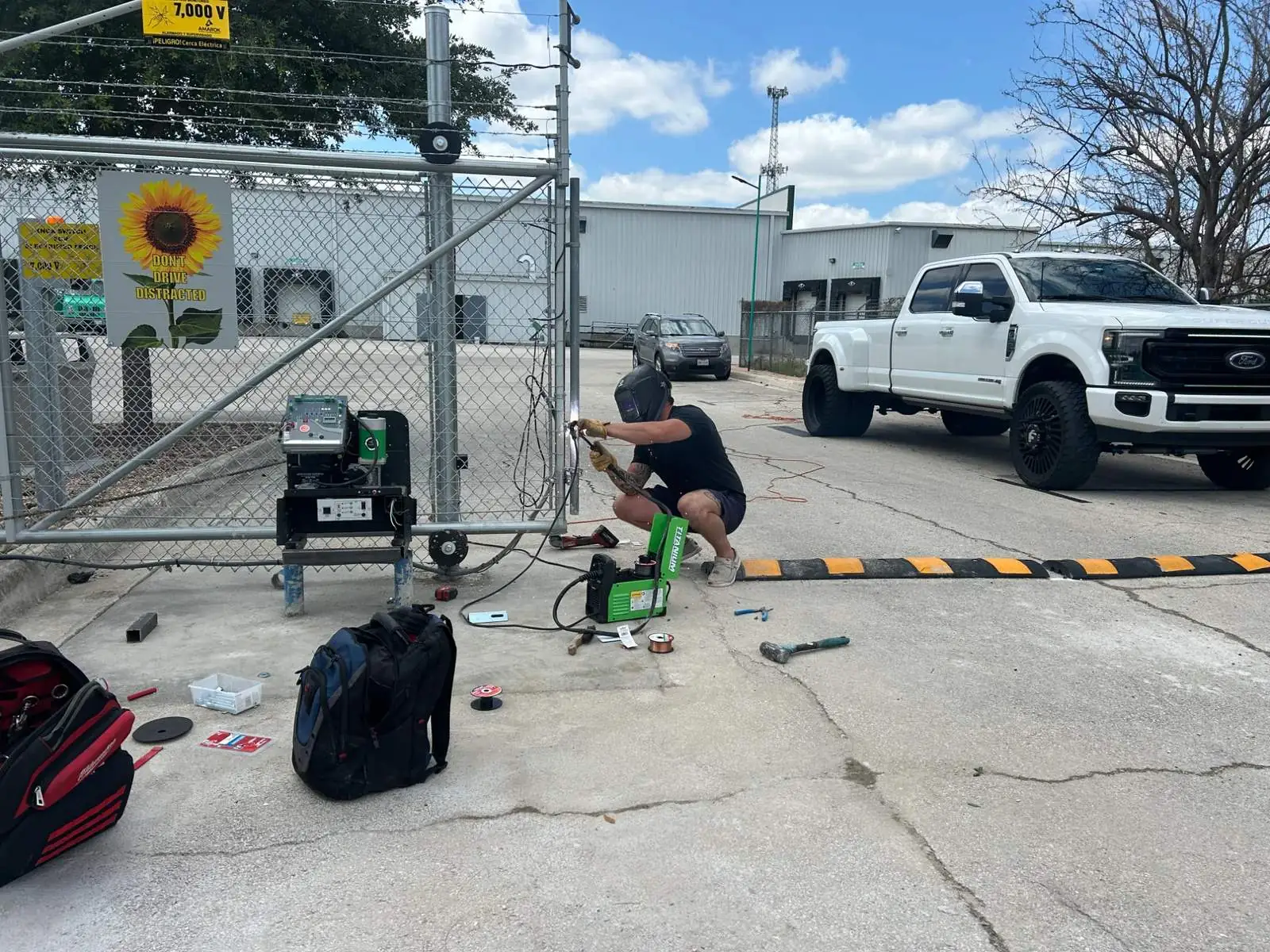
We charge $89 for a service call, and we would rather earn it fixing something real than resetting a tripped breaker you could have flipped yourself. About half the “dead gate” calls we run across Houston end in something the homeowner could have checked in five minutes. Here is exactly what to check, in order, before you call anyone.
1. Check the Power First — Seriously
It sounds insulting. It is also the number one cause. Gate operators are usually fed from an outdoor GFCI outlet or a dedicated breaker, and both trip — especially after Houston thunderstorms. Find the outlet near your operator and press the reset button if it has one. Then check your breaker panel for anything tripped. If your operator has a status light, no light means no power, and no power is an electrical problem, not a gate problem.
2. Check the Battery Backup
Most modern operators have a backup battery that keeps the gate running through outages. These batteries last 3-5 years in Houston heat — then they die, and a dead backup battery can cause bizarre behavior: slow movement, half-opens, random stops, or a gate that works in the morning and quits by afternoon. If your battery is more than 3 years old and your gate is acting possessed, the battery is the prime suspect. Replacements run $40-$120 and swapping one is a ten-minute job on most units.
3. Try a Different Remote — and the Keypad
If the gate ignores your remote but opens from the keypad, the gate is fine — your remote battery is dead or the remote has lost its pairing. Remote coin batteries (CR2032 class) die roughly every two years. Swap the battery before assuming anything worse. If the keypad also does nothing, move to the checks below.
4. Look at the Safety Sensors
If your gate opens fine but will not close — or starts closing and reverses — the entrapment sensors are telling the operator something is in the path. Nine times out of ten, nothing is: the sensor eyes are dirty, spider-webbed (a Houston classic), or knocked out of alignment by a weed trimmer. Wipe both sensor eyes with a dry cloth and check they point directly at each other. This one check resolves an enormous share of “gate won't close” calls.
5. Check for Physical Obstructions
Walk the full gate path. For slide gates, look at the track — rocks, mud, leaves, or a kid's toy in the track will stop the gate cold. For swing gates, check that nothing is blocking the leaf arc and that the gate has not dropped and started dragging on the driveway. A gate that drags is an alignment problem (usually a heaved post — thank Houston clay) and no amount of button pressing fixes it.
6. Test the Manual Release
Every operator has a manual release — a key or lever that disconnects the motor so you can move the gate by hand. Release it and push the gate. If it glides smoothly, the gate hardware is fine and your problem is electrical or in the operator. If it is heavy, grinds, or fights you, the problem is mechanical — hinges, rollers, or alignment — and the operator has probably been straining against it for months.
7. Listen to What the Operator Does
Press the button and listen. Nothing at all: power or control board. Humming but no movement: failed capacitor or stripped drive gear — stop pressing, you are cooking the motor. Clicking: usually a relay firing with insufficient voltage — often that dead backup battery again. Runs but gate moves partway and stops: limit switch drift or an obstruction mid-path.
When It Is Time to Call
If you have run all seven checks and the gate still does not work, you have a real failure: control board, capacitor, motor, drive gear, or wiring. These are not DIY repairs — gate operators combine high-torque machinery with mains voltage, and guessing gets expensive or dangerous.
Our $89 service call covers the full diagnostic: power, board, motor, gears, sensors, limits, and the gate hardware itself. We tell you exactly what failed, what it costs to fix, and whether repair or replacement is the smarter money. And if it turns out to be something from this list — we will tell you that too, and you will only be out the service call instead of a mystery repair bill.
$89 diagnostic — we find the real problem today
We call back within 30 minutes. Same-day service available across Houston, The Woodlands, Katy, Spring, and surrounding areas.