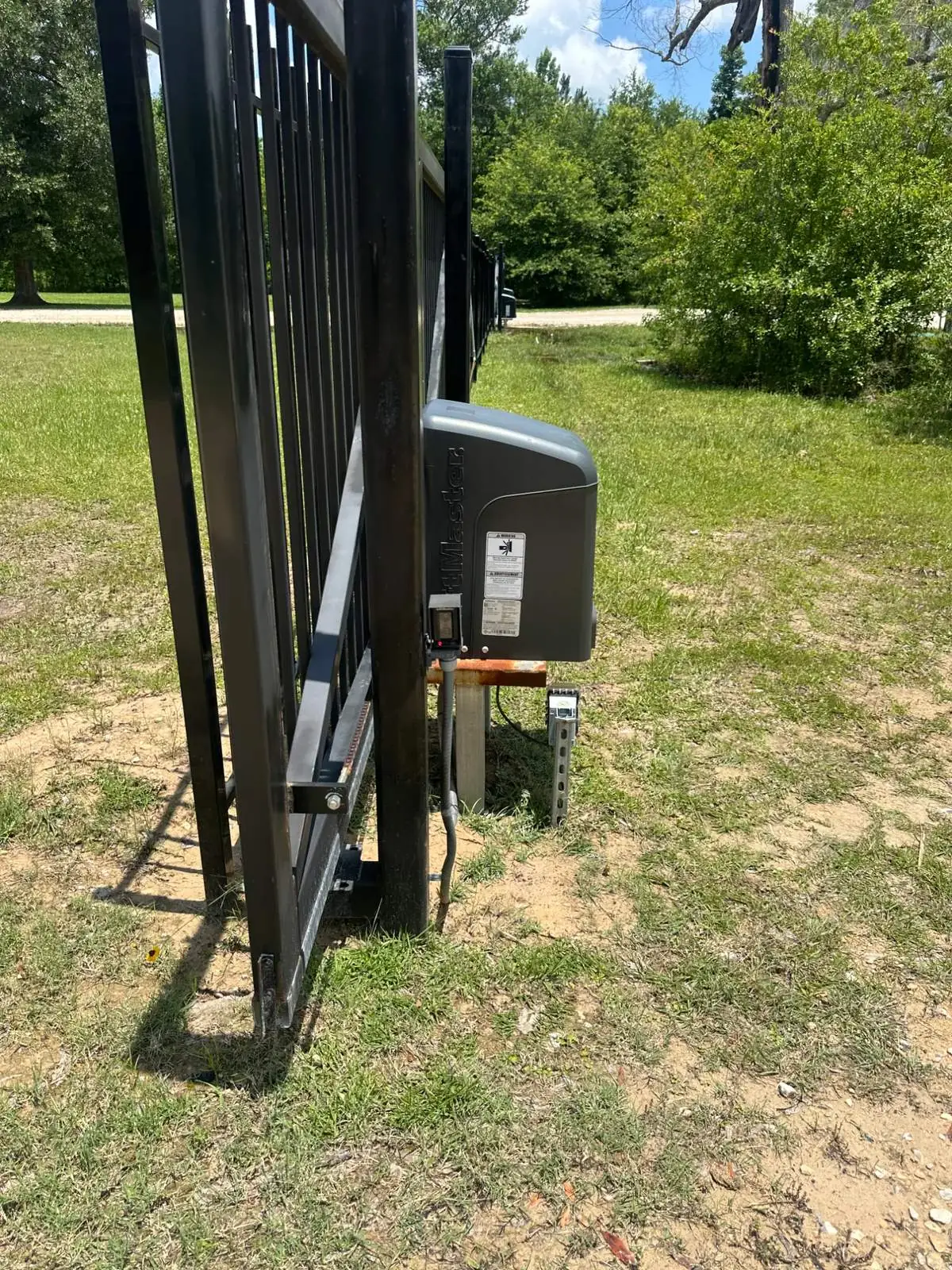
A gate operator does not just stop working out of nowhere. Before it fails completely, it sends warning signals — sounds, behaviors, and patterns that tell you something is wrong. Most Houston homeowners and property managers miss these signs until it is too late and the gate is stuck open, stuck closed, or completely unresponsive.
We have serviced hundreds of gate openers across Houston, The Woodlands, Katy, and Spring. The brands change — LiftMaster, Viking, Apollo, Elite — but the warning signs are almost always the same. Here are the five you need to know.
1. Grinding, Clicking, or Unusual Noises During Operation
A healthy gate opener runs with a consistent, low hum. If yours has started making grinding, clicking, squealing, or scraping noises — that is a mechanical problem that is actively getting worse with every cycle.
What it usually means: Worn drive gears, stripped sprockets, or a motor bearing that is breaking down. On rack-and-pinion operators like the LiftMaster SL585 or Viking E-50, grinding almost always points to a worn drive gear that has lost its teeth. Left alone, this progresses from annoying to catastrophic — a stripped gear means the operator runs but the gate does not move, and replacing a drive assembly costs significantly more than catching it early.
What to do: Do not ignore it. Call for a service visit before the gear gives out completely. A worn gear caught early is a straightforward parts swap. A failed motor assembly is a far larger job — and it is exactly where a neglected gear ends up.
2. Slow or Inconsistent Response to Commands
If your gate used to open within two seconds of pressing the remote and now takes five to eight seconds — or sometimes does not respond at all on the first press — something is wrong. This is not normal wear. This is a warning.
What it usually means: Several possibilities, and all of them matter. A failing capacitor means the motor cannot start under load, so it hesitates. A corroded control board connection causes intermittent signal dropout. A dying battery backup or failing transformer means the operator is not getting consistent voltage. On CellGate and LiftMaster myQ installations, inconsistent response can also point to a cellular or Wi-Fi connectivity issue at the board level.
What to do: Check your battery backup first — many operators have a 12V or 24V backup battery that goes dead after 3-5 years and causes exactly this symptom. If replacing the battery does not fix it, a technician needs to check board voltage and capacitor health.
3. The Gate Reverses Randomly or Will Not Close Fully
Your gate opens fine but when closing, it gets halfway down and then reverses back open. Or it closes most of the way but stops an inch or two short. You have to try two or three times to get it to latch. This is one of the most common service calls we get across Houston.
What it usually means: The most common cause is a misaligned or dirty safety sensor. Most residential gate operators have entrapment protection sensors — small photocell or magnetic sensors that tell the operator “something is in the path, stop and reverse.” When these sensors get dirty, corroded, or knocked out of alignment, the operator thinks there is an obstruction when there is not.
The second most common cause is a limit switch that has drifted out of position. The limit switches tell the operator where “fully open” and “fully closed” are. When they drift, the gate stops short or reverses prematurely.
What to do: First, clean the sensor eyes with a dry cloth and make sure they are pointed directly at each other. If that does not fix it, the limit switches need to be adjusted — something a technician can do in under an hour on most models.
4. Physical Damage to the Gate or Hardware You Have Been Ignoring
A bent hinge. A cracked weld at the top corner. Rust forming at the pivot point. A gate post that has shifted slightly. These are not just cosmetic issues — they put extra load on your gate operator every single cycle.
What it usually means: Your operator is working harder than it was designed to in order to move a gate that is out of alignment or heavier than it should be. Over time, this burns out motors faster, wears gears prematurely, and stresses the drive chain or rack. We regularly see operators that should last 15 years fail in 5 or 6 because the gate itself was never properly maintained or repaired after minor damage.
What to do: Repair structural damage to the gate and hardware before it kills your operator. A weld repair and hinge replacement is a far smaller job than an operator replacement. If you are unsure whether your gate alignment is contributing to operator wear, a $89 service call will get eyes on the whole system.
5. The Operator Is Running But the Gate Is Not Moving
You press the button, you hear the motor running, but the gate does not move — or moves only a few inches before stopping. The motor sounds normal. Nothing looks broken. But the gate is not going anywhere.
What it usually means: This is almost always a stripped drive gear or a broken drive chain/rack connection. The motor is working, but it has nothing to grab onto. On swing gate operators, it can also be a sheared clevis pin or broken arm attachment. On slide gates, a broken chain or rack tooth.
What to do: Do not continue pressing the button and hoping. Running the motor without a load connected accelerates motor wear. This is a mechanical repair that needs a technician — parts need to be inspected and replaced before the gate will move again.
How Long Should a Gate Opener Last?
A properly maintained residential gate opener should last 10-15 years. A commercial-grade operator like the LiftMaster CSW200 or Viking PT-1000 is designed for 300,000+ cycles and can last 20 years with proper maintenance. Most operators fail early because of deferred maintenance, structural gate problems, or power issues — not because the operator itself is poorly made.
The brands we install and service — LiftMaster, Viking, Apollo, and Elite — are all premium products with excellent part availability. In most cases, a failing operator can be repaired rather than replaced, especially if the issue is caught before complete failure.
What Happens During a Texas Gates Service Call
When you call us for a service visit, we charge a flat $89 service call fee. Here is what that covers:
- Full visual inspection of the gate structure, hardware, and welds
- Operator diagnostic — motor, gears, capacitor, control board, sensors, limit switches
- Remote and access control function test
- Identification of the specific fault or failure mode
- Written quote for any required repairs
If you approve the repair on the spot, the $89 is applied toward your total. If you decide not to proceed, you only pay the service call fee. No pressure, no obligation beyond the diagnostic.
Most repairs we diagnose can be completed same-day if we have the parts on the truck — which we usually do for the most common failures on LiftMaster, Viking, Apollo, CellGate, and DoorKing systems.
Get a technician out today — $89 service call
We call back within 30 minutes. Same-day service available across Houston, The Woodlands, Katy, Spring, and surrounding areas.