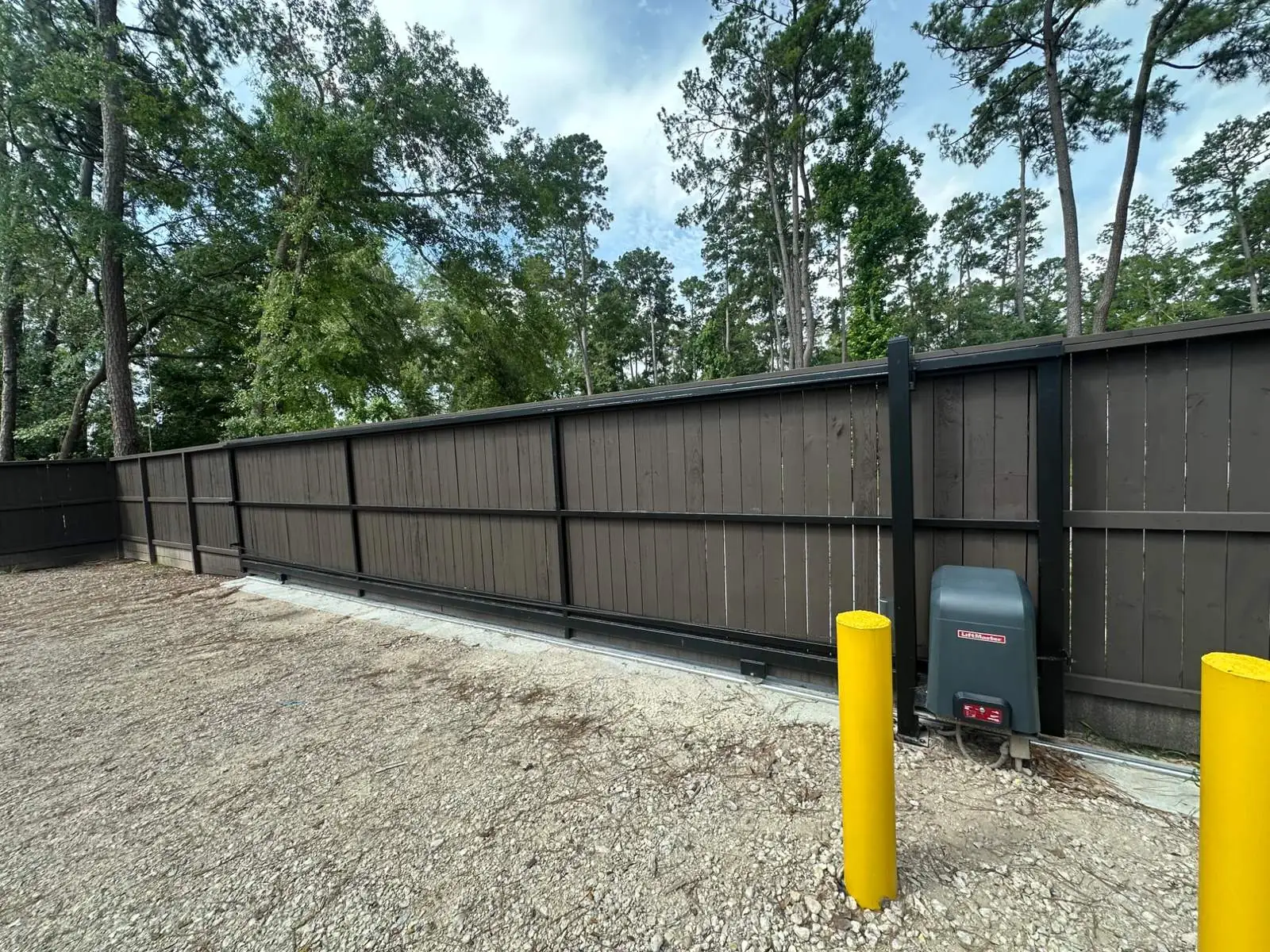
A residential gate might open and close 4-6 times a day. A commercial gate at a warehouse, storage facility, or car lot might cycle 50-200 times daily. That difference is not just a matter of volume — it fundamentally changes how you need to think about maintenance, inspection intervals, and operator selection.
We maintain and service commercial gate systems across Houston for storage facilities, warehouses, apartment complexes, car dealerships, school campuses, and industrial properties. The facilities that never have emergency failures are the ones that treat gate maintenance as a scheduled operational task, not something they deal with when it breaks.
Here is the complete maintenance framework we recommend to every commercial property manager we work with.
Understanding Your Commercial Gate Operator's Duty Cycle
Every commercial gate operator has a rated duty cycle — the number of operations per hour or per day it is designed to handle continuously. This is one of the most important specs that gets ignored when facilities buy operators based on price alone.
- Light commercial (20-40% duty cycle) — Suitable for low-traffic commercial applications: small office parks, low-volume gated communities. Operators like the LiftMaster LA500 fall here.
- Medium commercial (50-75% duty cycle) — Most storage facilities, mid-volume warehouses, apartment complexes. LiftMaster CSW200, Viking E-50, Apollo 3000 series operate in this range.
- Heavy commercial / industrial (100% continuous duty) — High-volume distribution centers, transit facilities, high-cycle parking. Viking PT-1000, LiftMaster SL3000UL, and heavy DoorKing slide operators.
If you are running a 40% duty cycle operator at 100% load, you are cutting its lifespan in half — at minimum. The first maintenance question any facility manager should ask is: am I running the right class of operator for my traffic volume?
Monthly Checks — What Your Staff Should Do
These are visual and functional checks that your on-site staff can perform without any tools or technical knowledge. They take 10-15 minutes and can catch problems before they become failures.
Visual Inspection
- Walk the full perimeter of the gate and check for visible damage — bent pickets, cracked welds, damaged bottom rail on slide gates
- Check all visible hardware — hinges, pivot pins, arm attachments, and mounting bolts for looseness or corrosion
- Inspect the track (slide gates) for debris, damage, or deformation
- Look for oil or grease stains under the operator housing that indicate a seal failure
- Check for vegetation growing into the track or near sensors
Functional Test
- Cycle the gate 3-5 times and listen for any new noises — grinding, clicking, or scraping that was not there before
- Note whether the gate is moving slower than usual in either direction
- Test all remote transmitters, keypads, and access control credentials — flag any that are not working
- Test the safety reverse function by holding a piece of cardboard in the gate path during closing
- Verify that the gate comes to a complete stop at both the open and closed limits without impact
Quarterly Professional Maintenance — What We Do
Quarterly professional maintenance is the standard we recommend for facilities that cycle their gate 20 or more times per day. Here is what a complete quarterly service visit from Texas Gates covers.
Gate Structure and Hardware
- Torque check all mounting hardware — hinge bolts, post anchors, arm attachments, and operator mounting bolts
- Inspect all welds for cracking, particularly at high-stress points (corners, hinge locations, arm attachment points)
- Lubricate all hinge pins, pivot points, and roller bearings with appropriate lubricant — heavy-duty chain lube for chains, grease for mechanical pivot points
- Check gate alignment — ensure the gate is plumb, square, and moving in its intended path without binding
- Inspect the bottom seal or sweep on slide gates and replace if worn
Operator Mechanical Components
- Inspect and lubricate the drive chain or rack-and-pinion drive with manufacturer-specified lubricant
- Check chain tension on chain-drive operators — adjust to manufacturer spec if slack or overtightened
- Inspect drive gears and pinion for wear — look for rounded teeth, which indicate imminent failure
- Check the motor coupling for wear or cracking
- Verify that the manual release mechanism is functioning and not seized
Electrical and Control Systems
- Test battery backup capacity — load test the backup battery and replace if it cannot hold charge above rated voltage under load
- Inspect all wiring connections at the control board for corrosion, looseness, or rodent damage (a common issue in Houston's climate)
- Check transformer output voltage against rated spec
- Test capacitor function on single-phase operators — a failing capacitor shows up as slow starts and is easy to replace before failure
- Inspect photocell sensors and clean lens surfaces — Houston humidity causes mineral deposits that degrade sensor function
- Test all loop detectors and ensure proper sensitivity setting
- Verify entrapment protection sensitivity meets UL 325 standards
Access Control Systems
- Test all active credential types — keypads, fobs, remotes, telephone entry, and cloud access (CellGate, myQ)
- Review and audit active user credentials — remove credentials for employees who are no longer with the company
- Check intercom function and audio quality if applicable
- Verify that entry log data is being recorded correctly on cloud-managed systems
- Test camera integration if applicable
Annual Service — Full System Overhaul
Once a year, we recommend a more comprehensive service that goes beyond the quarterly scope. The annual service is where we proactively replace components that are approaching end of life rather than waiting for them to fail.
- Battery replacement — Sealed lead-acid backup batteries typically have a 3-5 year lifespan. We replace them proactively at the 3-year mark on high-cycle applications.
- Drive chain or belt inspection and replacement if needed — Chains stretch over time and plates wear. An annual tension check with replacement at appropriate wear thresholds prevents drive failure.
- Control board inspection and cleaning — Dust, moisture, and insect activity (a real issue in Houston) accumulate on control boards. Annual cleaning and inspection catches corrosion before it causes board failure.
- Full lubrication service — All mechanical components, bearings, and pivot points receive fresh lubrication.
- Full UL 325 safety compliance check — Ensures the gate meets current entrapment protection standards.
- Documentation update — We update the service record and give you a written report of the system's current condition and any components approaching end of life.
The Cost of Deferred Maintenance
We track this carefully across the facilities we service. The math is consistent.
A quarterly maintenance contract covers scheduled inspection and adjustment on a predictable calendar. An emergency service call is the opposite — it lands in the middle of the business day, when the gate fails and vehicles cannot enter or exit. That is $89 for the service call, plus parts and labor on top. And the parts on a commercial system are the expensive end of the catalog: a control board failure on a Viking PT-1000 or LiftMaster SL3000, or a motor replacement, are among the largest component swaps on the gate — and both are frequently the endpoint of wear a scheduled inspection would have caught months earlier.
Beyond the repair cost, there is the operational cost. When a commercial gate fails at a storage facility, customers cannot access their units. When it fails at a warehouse, delivery vehicles cannot enter or exit. When it fails at a school, the security perimeter is compromised. These are not just maintenance budget items — they are operational risk items.
What to Look for in a Commercial Gate Maintenance Provider
Not all gate companies are equipped to handle commercial maintenance. Here is what we recommend looking for:
- Brand-specific experience — Your provider should have documented experience with the specific brand and model of operator you are running. LiftMaster commercial operators and Viking operators have different drive systems, control board architectures, and failure modes.
- Access control competency — If you are running CellGate, DoorKing, or myQ cloud access, your maintenance provider needs to be able to service and troubleshoot those systems, not just the mechanical operator.
- Parts availability — A good commercial gate service provider keeps the most common parts for major brands in stock. Waiting a week for a part to be ordered means a week of downtime or a gate stuck in an unsafe position.
- Written service records — Every maintenance visit should produce a written record of what was inspected, what was found, what was done, and what is recommended for future attention. This protects you from liability and gives you a maintenance history if ownership or management changes.
- Response time — When a commercial gate fails, you need someone who can be there the same day, not in 3-5 business days.
Texas Gates Commercial Maintenance Programs
We offer quarterly and annual maintenance contracts for commercial properties across Houston. Every contract includes:
- Scheduled quarterly visits with full mechanical and electrical inspection
- Priority response on emergency service calls — commercial contract customers go to the front of the line
- Discounted parts pricing on any repairs needed
- Written service report after every visit
- Access control audit and credential management at every visit
- Annual full system assessment with written condition report
We service LiftMaster, Viking, Apollo, CellGate, and DoorKing systems across Houston, The Woodlands, Katy, Spring, Conroe, Cypress, and Sugar Land.
Ask about our commercial maintenance contracts
Prevent failures before they happen. We offer quarterly and annual service contracts for commercial gates across Houston. Call us or submit a request and we will get you a quote.