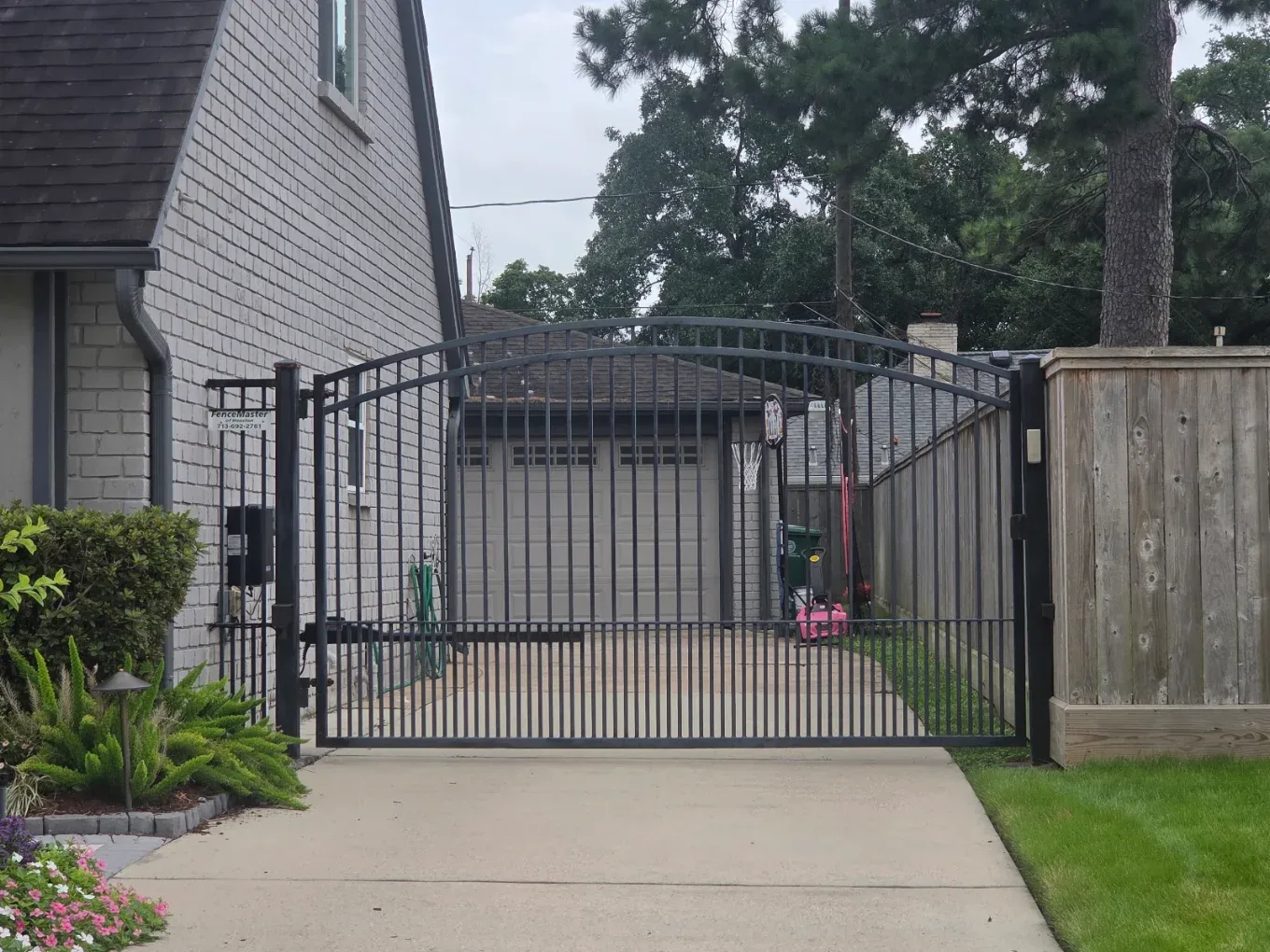
An iron gate that will not close is more than an annoyance. It is a security gap, it is an HOA letter waiting to happen, and on an automatic gate it usually means something is about to break for good. Here are the seven causes we see most often on Houston iron gates, roughly in order of how common they are. If your gate is automatic and opens fine but reverses or refuses to close, start with our guide to safety-system faults — this article covers the mechanical side.
1. The Gate Has Sagged on Its Hinges
How to spot it: the latch side of the gate sits lower than the hinge side. The leaf drags on the driveway, or the latch now sits an inch below where it needs to be.
Why it happens: hinges wear out. The steel pin inside a weld-on hinge slowly grinds down, or the bushing collapses, and the leaf drops. Heavy ornamental iron does this faster because there is more weight pulling on the hinge every hour of every day.
The fix: worn hinges get replaced, not adjusted. Adjustable hinges buy time, but if the pin is worn the sag comes right back. We walk through the whole process in How to Fix a Sagging Iron Gate.
2. The Post Has Shifted or Leaned
How to spot it: put a level on the hinge post. If it is out of plumb — especially leaning toward the driveway — the whole gate geometry has changed and the leaf swings wrong.
Why it happens: this is a Houston special. Our expansive clay soil swells when it rains and shrinks when it dries, and a post set in a shallow footing gets pushed around season after season. Posts near tree roots or in poorly drained spots move even more.
The fix: sometimes a leaning post can be straightened and re-set with additional concrete. If the footing is cracked or the post is rusted at the base, it needs to come out and be replaced — set 30 to 36 inches deep with a belled footing to resist heaving.
3. The Latch Is Misaligned or Worn
How to spot it: the gate swings all the way to the closed position but the latch does not catch, or catches only if you lift the gate slightly.
Why it happens: usually a symptom of #1 or #2. Occasionally the latch itself is bent, the strike plate has come loose, or the latch spring has rusted solid.
The fix: if the gate and post are still square, the latch can be repositioned or replaced in under an hour. If they are not, fixing the latch alone is a temporary patch and you will be back here in a few months.
4. Something Is Blocking the Swing or Track
How to spot it: the gate stops short at the same spot every time.
Why it happens: on swing gates, the usual suspects are settled pavers, tree roots lifting a section of driveway, or gravel buildup. On slide gates, it is debris in the track, a bent track section, or a flat-spotted roller. After heavy rain, mud and leaf litter packed into a slide-gate track is one of the most common calls we run.
The fix: clear the obstruction. If the driveway itself has heaved, the gate may need to be re-hung slightly higher or the concrete ground down. If the track or rollers are damaged, see our slide-gate grinding guide.
5. The Gate Frame Has Bent or Twisted
How to spot it: sight down the top rail. If it is no longer straight, or the leaf is twisted so one corner sticks out, the frame is compromised.
Why it happens: vehicle impact is the number one cause — someone backs into it, or a delivery truck catches it. Wind loading during storms twists lighter gates, and rust can weaken joints until the frame racks under its own weight.
The fix: minor bends can be heated and straightened by a fabricator. Severe twisting or cracked welds usually means rebuilding the affected section. This is fabrication work, not something a general handyman should attempt.
6. The Operator Is Out of Adjustment
How to spot it: the gate starts to close, then stops or reverses before reaching the latch post. Or it closes but never fully seats.
Why it happens: gate operators have close limits (where the motor stops) and force settings (how much resistance triggers a reversal). If the gate has sagged or a post has moved, the operator is still driving to the old close point. If the gate is dragging, the operator senses resistance and reverses, thinking it hit something.
The fix: re-set the limits and force. But if the underlying cause is mechanical, adjusting the operator only works briefly. An operator that keeps reversing partway through closing is usually telling you the gate needs a mechanical repair first.
7. A Safety Device Is Triggering
How to spot it: the gate closes partway then stops or reopens, even though it moves freely by hand.
Why it happens: photo eyes may be dirty, misaligned, or blocked by a shrub that has grown into the beam path. Ground loops develop faults. Some gates have an edge sensor that reverses if pressed — and if its wire is damaged, it may read as constantly pressed.
The fix: clean the lenses, trim anything in the beam path, and check the alignment indicator lights. Loop faults need a loop detector test with a meter.
Quick Diagnostic: Which One Is It?
- Gate drags on the ground — sagging hinges (#1) or a leaning post (#2)
- Latch is too high or low — sag, post shift, or latch misalignment (#1, #2, #3)
- Stops at the same spot every time — obstruction (#4)
- Frame visibly crooked — bent frame (#5)
- Automatic gate reverses before closing — operator force/limits (#6) or safety device (#7)
- Moves freely by hand but not with the operator — operator or safety device (#6, #7)
Should You Fix It Yourself?
Clearing a track, cleaning photo eyes, and tightening a loose latch are safe DIY tasks. Anything involving hinges, posts, welding, or operator control boards is a job for a professional. Iron gates weigh hundreds of pounds, and a leaf that comes off its hinges can cause serious injury. Operator control boxes also carry line voltage.
We find the real cause, not just the symptom
We inspect the full gate system and give you a written estimate before any work starts. Same-day service across Houston, The Woodlands, Katy, Spring, and surrounding areas.