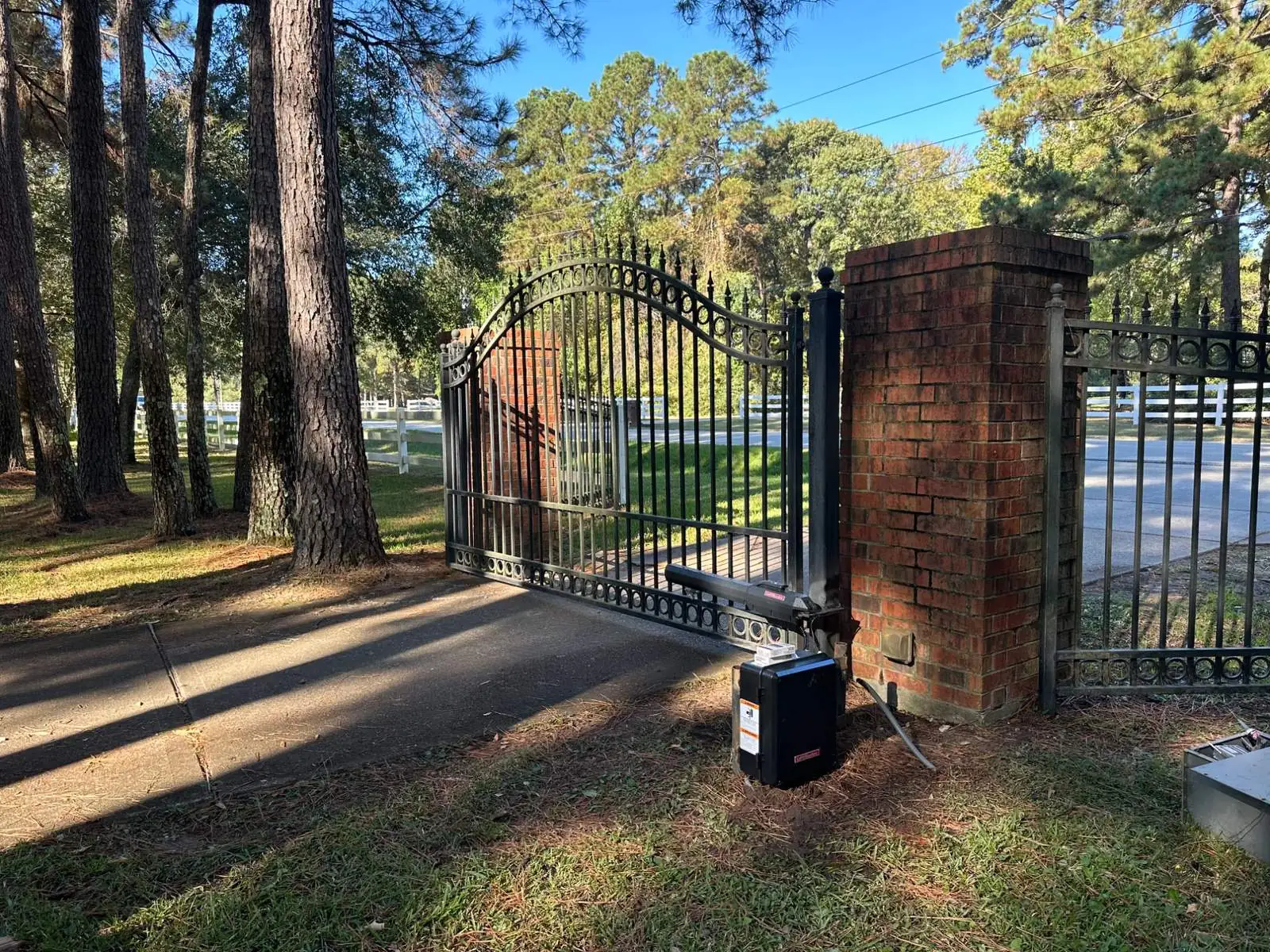
A gate that opens normally but will not close is almost always a safety system doing its job. Photo eyes, safety edges, and loop detectors are all designed to block the closing cycle when they detect an obstruction or a fault, while opening stays permitted because opening is the safe direction. That asymmetry tells you exactly where to look.
Why Opening Still Works
Gate operators treat the two directions very differently. Closing a gate can crush a vehicle, a pet, or a person, so it sits behind every safety device on the system. Opening carries far less risk, so it is allowed even when several safety inputs are unhappy.
This is required behavior under UL 325, the safety standard governing automatic gate operators. When a safety device reports an obstruction or fails outright, a compliant operator refuses to close and will often park itself open until the fault clears.
So this is not a random symptom. It is the system telling you a safety device is either triggered or broken.
Photo Eyes: The Most Common Cause
Photo eyes are the paired sensors mounted low on either side of the gate opening. One transmits an infrared beam, the other receives it. Break the beam and the gate will not close.
Misalignment. A lawn mower clip, a bumped post, a delivery driver backing into the housing, or gradual settling over a season. The beam only needs to be off by a small margin to lose the receiver.
Sun glare. Low-angle morning and evening sun striking the receiver directly can saturate it. If your gate refuses to close reliably at roughly the same time each day and works fine at midday, this is the likely explanation. It is very common on east-west driveways across the Houston area.
Dirt, spider webs, and mud dauber nests. Lenses collect grime, and this region has no shortage of insects that build directly on warm plastic housings. A web across the lens scatters the beam enough to break it.
Water intrusion. Cracked housings let in rain. Fogged or corroded internals produce intermittent faults that come and go with the weather.
Wiring damage. Buried or conduit-run wiring gets nicked by landscaping, chewed by rodents, or corroded at splice points. A partially failed conductor produces exactly this behavior.
Start by looking at the indicator LEDs on both photo eye units. Most models show a steady light when aligned and receiving, and flash or go dark when blocked. Wipe both lenses and see whether the indicator changes.
Safety Edges
Safety edges are the rubber strips mounted along the leading edge of the gate, and sometimes along the trailing edge or gate posts. They contain a pressure-sensitive switch that stops and reverses the gate on contact.
When an edge fails, the operator reads it as permanently pressed and refuses to close.
Edges fail from UV exposure, cracking, water getting into the strip, and physical damage. In this climate sun degradation is the usual culprit — the rubber hardens and splits after a few seasons of direct exposure, water gets in, and the switch shorts.
An edge that is cracked, spongy, separated from its channel, or visibly weathered needs evaluation. This is not a component to bypass or disconnect, since it exists specifically to prevent crush injuries.
Loop Detectors
If your gate has vehicle detection loops embedded in the driveway surface, a stuck loop will hold the gate open. Both the exit loop and the safety loop do this. If the detector believes a vehicle is sitting on the loop, it keeps the gate open indefinitely.
Causes include a cut loop wire from driveway cracking or repaving, water in the loop sealant, a failed detector module, or a detector that has drifted out of tune. Driveway movement from the expansive clay soils common across Montgomery County is a frequent contributor.
The tell: the gate holds open with nothing in the driveway, and the loop detector module inside the control box shows a constant detect indicator rather than a clear one.
Timer and Setting Issues
Not everything is a hardware fault.
- Timer to close disabled or set very long. Many gates close automatically after a set delay. If that timer was disabled during a service visit, the gate is waiting for a close command it never receives.
- Hold-open mode engaged. Most operators have a hold-open or vacation mode, sometimes triggered accidentally from a keypad sequence or a remote button.
- Emergency access override latched. Systems with siren-detect or fire department access devices can latch open after being triggered, and some require a manual reset.
If your gate was closing normally and stopped without any physical damage or weather event, a setting change is worth ruling out before assuming a part failed.
What Not to Do
There is a real temptation, when a gate will not close, to disconnect the photo eyes or bypass the safety edge so the thing will just work.
Do not. These devices exist because automatic gates have caused serious injuries and deaths, disproportionately to children. Bypassing them also puts the installation outside UL 325 compliance, which can matter for insurance and, on commercial or HOA properties, for liability exposure.
If a safety device is faulty, the fix is repairing or replacing it — not removing it from the circuit.
Getting It Resolved
A gate stuck in the open position is a security problem as well as an inconvenience, and the underlying cause ranges from a lens cleaning to a failed control board. If the gate is also reversing partway through a close cycle, that is a closely related fault with an overlapping cause list.
We service automatic gate safety systems throughout the north corridor, including Spring, Conroe, Magnolia, and The Woodlands.
That is a security issue — let us get someone out
We call back within 30 minutes. Same-day service available across Houston, The Woodlands, Conroe, Spring, and surrounding areas.