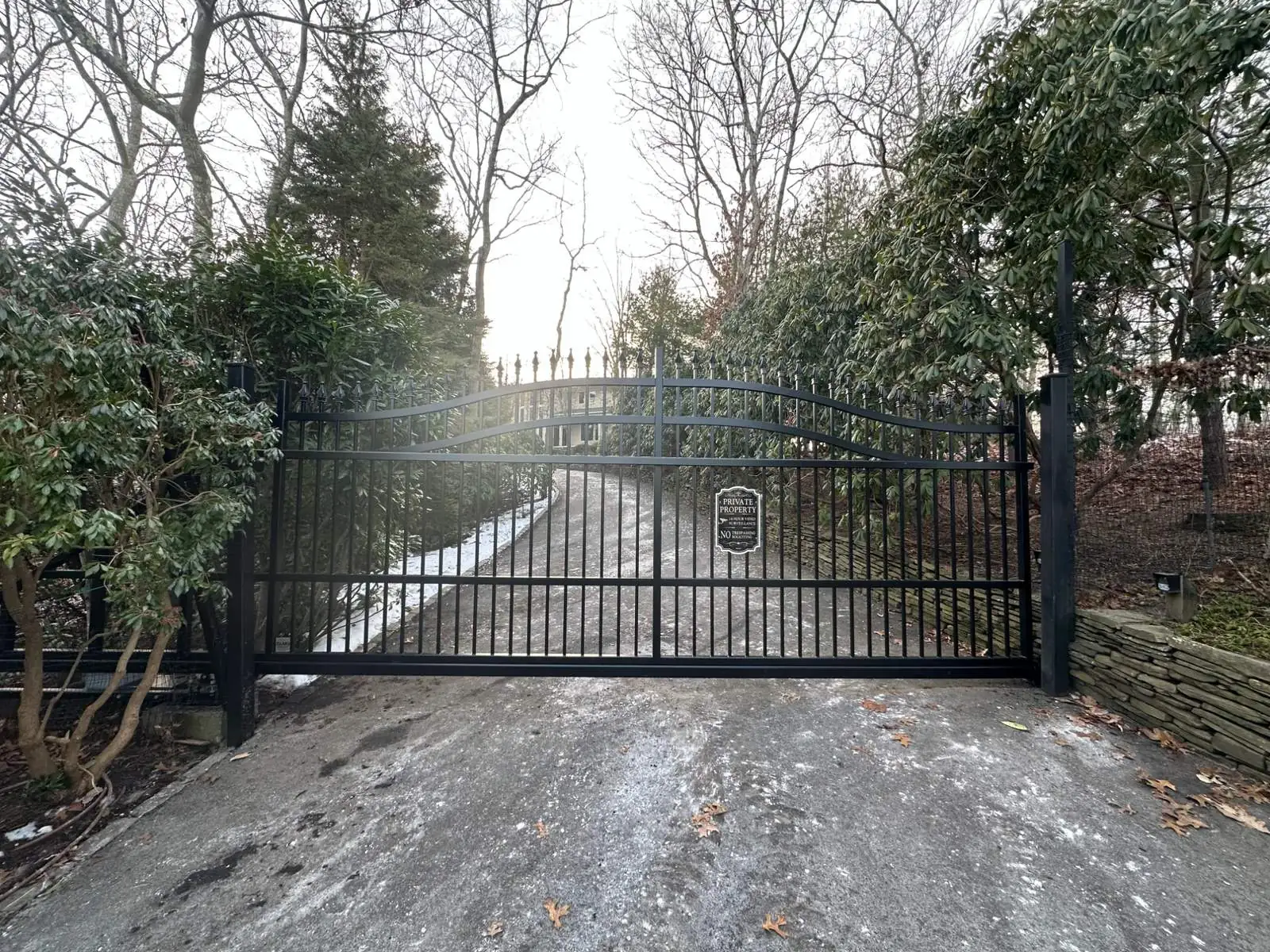
The most common mistake we see is a gate chosen in isolation — a design someone liked on a website, dropped in front of a house it has nothing to do with. A gate that fits looks like it came with the property. Here are the decisions that get you there, roughly in the order they matter.
Start With the Top Line
The silhouette does more visual work than any ornament, and there are really only a few:
- Arched (crown). Rises to a peak in the center. Traditional, formal, and the most common choice on brick and stucco homes across Houston. Reads well between columns.
- Inverted arch (sway). Dips in the center instead. Softer, slightly more contemporary, and it makes a wide opening feel less like a wall.
- Flat top. Straight across. Quiet, modern, and the right call when the house already has a lot going on architecturally.
- Stepped or split arch. Two leaves each with their own rise, meeting at the center. Suits wider estate entrances.
Match the top line to your roof and entry. A house with strong gables and arched windows takes an arched gate naturally. A low, horizontal modern house fights one.
Then Pick the Infill
The infill is what fills the frame, and it sets both style and privacy:
Vertical pickets
The default, and the most versatile. Spacing changes the whole feel: tight spacing reads formal and secure, wider spacing reads open and lets you see the property. Keep spacing narrow enough that a small child cannot get through — usually four inches or less.
Ornamental scrollwork
Hand-formed scrolls, rings, and quatrefoils worked into the panel. This is the classic Houston estate look, and it is where a fabricating shop earns its keep — the pattern can be designed to echo a detail from the house, a stair rail, or an existing fence. It is also the style that makes repairs a fabrication job rather than a parts swap, which is worth knowing going in.
Modern horizontal
Horizontal slats or tubes instead of vertical pickets. Clean, contemporary, and increasingly common on new builds in the Heights, Montrose, and EaDo. Works best with a flat top and simple posts.
Wood infill on a steel frame
A steel structure with cedar or composite panels. Warm, private, and good for backyard-facing driveways. It needs refinishing every few years in our climate — the steel frame is what keeps it square while the wood weathers.
Solid or privacy panels
Sheet metal, perforated steel, or louvered panels for full screening. Note that solid gates catch a lot of wind, which matters on the Gulf Coast; they need heavier frames, deeper footings, and stronger operators.
Pipe and wire
The ranch standard — welded pipe frame with wire or cattle panel. Utilitarian, tough, and the right answer on acreage. More on that in ranch gates and Texas gates.
Details That Change the Character
- Finials. Spear points, ball caps, or a plain flat top on each picket. Spears read formal and traditional; flat tops read modern.
- A belly band. A horizontal decorative band across the lower third — rings, scrolls, or twisted bar — that breaks up a tall panel.
- Columns. Brick, stone, or stucco columns on either side change the gate more than the gate does. They also give you somewhere to put lights, an address plaque, and a keypad.
- Address and monogram panels. A cut or forged medallion at the center of the leaves. Do it once and do it well; it dates fast when it is overdone.
- Lighting. Column lanterns, uplights on the gate, or fixtures on the posts. Worth planning during the install while the trench is open.
Color and Finish
Satin or matte black is the default in Houston for a reason — it disappears against landscaping and hides dust. Dark bronze and oil-rubbed finishes suit stucco and Mediterranean homes. Anything lighter shows every water spot in our humidity. Whatever the color, the finish system matters more than the shade: a powder coat over a properly prepared surface will hold up for years where a field-sprayed enamel starts bleeding rust in a couple of seasons.
Let the Site Rule Out Options
Design gets easier once the site has vetoed some choices. An uphill driveway rules out most swing gates. A narrow lot with no room inside rules out a swing gate that opens inward. A wide opening pushes you toward a slide, a dual swing, or a heavier frame. Wind exposure argues against solid infill. And the design has to leave room for the operator, the photo eyes, and the keypad to go somewhere that does not look like an afterthought. Swing vs slide covers the mechanics of that decision.
Match the Neighborhood Without Copying It
Deed-restricted neighborhoods often have a prevailing style, and in some the architectural committee will hold you to it. Look at what is already on your street, then aim for something in the same family that is clearly yours — a different top line, a different picket rhythm, a detail borrowed from your own house. Our HOA guide covers what committees typically approve.
The Test
Stand at the end of your driveway and look at the house. Whatever repeats — the arch over the front door, the rhythm of the porch columns, the vertical mullions in the windows, the horizontal courses of brick — is your design brief. A gate that picks up one of those and repeats it will look inevitable. Everything else is decoration.
For ideas grounded in real Houston properties rather than catalog renderings, browse our project gallery.
We draw it, fabricate it, and install it in-house
Bring a photo of your house and we will design a gate that belongs on it. Free site visits across Houston, The Woodlands, Katy, Spring, Cypress, Sugar Land, and surrounding areas. More on our gate installation page.