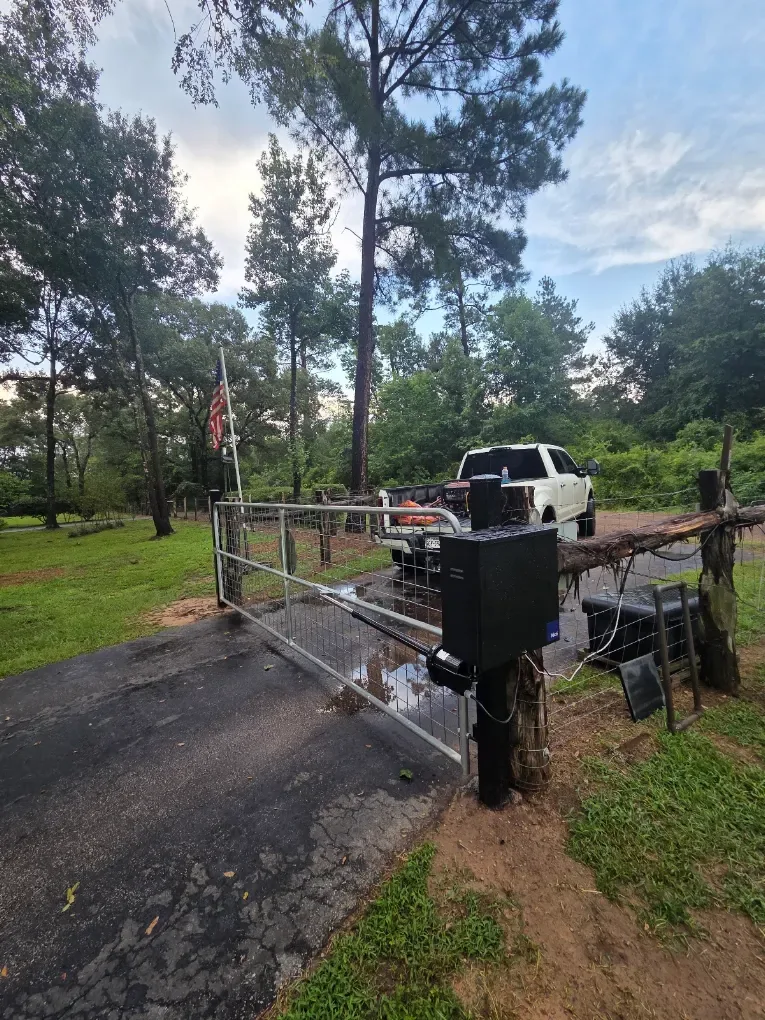
Outside the United States — Canada and Australia especially — the term “Texas gate” means a cattle guard: a set of parallel steel bars laid over a shallow pit across a roadway. Vehicles roll over it. Cattle, horses, and most livestock will not step on it, because their hooves would slip between the bars. It is a gate with nothing to open. Here in Texas we mostly just call it a cattle guard, but the name stuck elsewhere because the design spread with Texas ranching.
How a Texas Gate (Cattle Guard) Works
The concept is simple. A pit is dug across the entrance, typically 6 to 8 feet wide in the direction of travel and as wide as the road. A steel frame with round or flat bars spaced about 4 inches apart is set over the pit, flush with the road surface. Livestock see the gaps and the void below and refuse to cross. Vehicles drive over the bars without slowing down.
There are three common styles:
- Pit-style cattle guard — the traditional version, a steel grid over an excavated and usually concrete-lined pit. Rated for heavy loads; used on ranch roads that see trucks and trailers.
- Boxed or flat-bottom cattle guard — a self-contained steel unit with its own base that sits on the ground or in a shallow trench. Easier to install and relocate, and the base keeps it from sinking.
- Painted-stripe “virtual” cattle guard — white stripes painted on the road to mimic bars. Works on some cattle for a while, fails on horses and on cattle that figure it out. We do not recommend relying on one.
Texas Gate vs. Ranch Gate: Which Does Your Property Need?
A cattle guard and a swinging ranch gate solve different problems, and plenty of properties end up with both.
Choose a cattle guard when
- The priority is containing livestock while letting vehicles pass without stopping
- The road sees frequent traffic — feed trucks, trailers, ranch hands — and stopping to open a gate every time is impractical
- Security is not the concern; a cattle guard keeps animals in, not people out
Choose a swing or slide gate when
- You want to control who enters — a cattle guard stops cows, not cars
- The entrance is a residence or a property with equipment worth protecting
- You want an automatic operator with a keypad, remote, or phone access
- The entrance is the front of the property and appearance matters
The most common setup on Texas acreage is a cattle guard on interior ranch roads and a proper entrance gate — usually a pipe-and-iron ranch gate, often automated — at the road frontage. Some owners put both at the front: a cattle guard in the driveway as backup so an open gate does not mean loose cattle.
What Ranch Gates in Texas Actually Look Like
“Ranch gate” in Texas usually means one of a few things:
- Pipe gates. Welded steel pipe frames, 12 to 20 feet wide, sometimes with a cattle panel or wire infill. Utilitarian, tough, and the standard for pasture entrances.
- Ranch entrance gates. The statement piece at the road — a wide pipe or ornamental iron gate, often a dual swing, frequently with an overhead arch or name sign, and set between stone, brick, or heavy timber columns.
- Ranch-style residential gates. On acreage properties in Montgomery, Magnolia, Tomball, Waller, and Fulshear, the ranch look is applied to a normal driveway gate: horizontal rails, a rustic finish, and an automatic operator so nobody has to get out of the truck.
The choice between swing and slide matters on ranch entrances because these gates are wide. A 20-foot dual swing needs clearance on the inside for both leaves to open; a slide gate needs 20 feet of fence line beside the opening to slide into.
Automating a Ranch Gate
Ranch entrances are exactly where automatic operators earn their keep, and exactly where they get installed wrong. Long, heavy pipe gates need commercial-grade operators, not the residential unit sold for a 10-foot suburban gate. Remote entrances without power are the best case for solar operators, as long as the panel is sized for the gate weight and cycle count. And because ranch gate posts are set in the same expansive clay as everyone else’s, footing depth decides whether the gate still swings true in five years.
So, Is Texas Gates a Cattle Guard Company?
No — we fabricate, install, automate, and repair driveway and entrance gates across Greater Houston, including ranch-style entrances on acreage north and west of the city. If you need a cattle guard, we can point you to the right supplier. If you need the gate at the front of the property to look right, open from your phone, and keep working through a Houston summer, that is what we do.
Wide gates, heavy operators, solar where there is no power
Free site visit and written quote across Houston, The Woodlands, Montgomery, Magnolia, Tomball, Fulshear, and surrounding counties. More on our gate installation page.