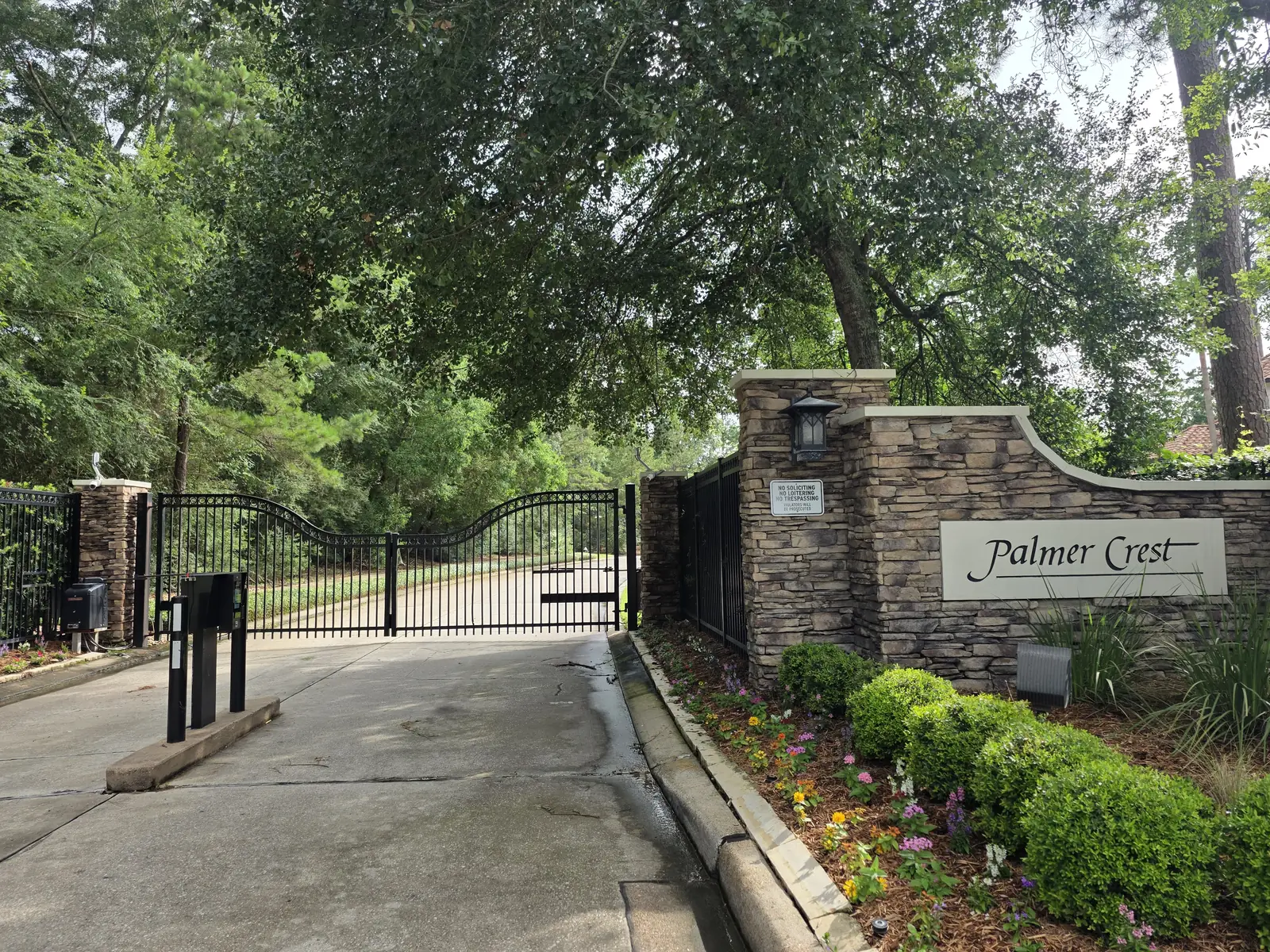
Iron rusts when it has oxygen and water, and Houston delivers both in enormous quantities year-round: relative humidity above 75% on average, roughly 50 inches of rain a year, and a Gulf breeze that carries salt well inland. Add lawn sprinklers hitting the gate every morning and you have about the most corrosive residential environment in the country. Here is how the damage actually progresses, and what to do about it.
Where Iron Gates Rust First
Rust does not attack a gate evenly. It starts in predictable places:
- The bottom 12 inches. Sprinkler spray, rain splash-back off the driveway, and morning dew all collect here. The base of the gate and the base of the posts are almost always first to go.
- Joints and welds. Anywhere two pieces of iron meet, there is a tiny seam where water sits. Scrollwork, picket-to-rail joints, and hinge welds are prime spots.
- Inside hollow tubes. Most “wrought iron” gates are actually hollow steel tube. Water gets in through a pinhole or an uncapped end, sits in the bottom of the tube, and rusts it from the inside out. By the time you see it, the wall is often paper-thin. This is why we do not recommend thin-wall tube-steel gates in Houston.
- Under peeling paint. Once paint lifts anywhere, moisture wicks under the edge and rust spreads sideways beneath the coating, invisible until the paint bubbles.
- The hinge side. Hinges are under constant stress and often lose their coating first. Rusted hinge pins are the leading cause of sagging gates.
The Four Stages of Rust Damage
Stage 1 — Surface rust
Orange discoloration on the paint or at bare spots, no pitting. Cosmetic and fully reversible with cleaning, priming, and repainting.
Stage 2 — Scale and pitting
Rust flakes off in layers and the metal underneath is visibly pitted. Still repairable, but the affected sections need to be ground to bare metal and properly treated before recoating.
Stage 3 — Structural loss
Pickets have holes, tube walls have collapsed, posts are rusted through at the base. Sections have to be cut out and replaced with new steel.
Stage 4 — Failure
The gate is unsafe to operate. A post snaps, a leaf tears off a hinge, or the frame folds. Full replacement.
Most gates we are called to in Houston are somewhere between stage 2 and stage 3. The difference between catching a gate at stage 1 and at stage 3 is the difference between a refinish and a rebuild.
Why Some Houston Gates Rust Faster Than Others
If your neighbor’s gate looks fine and yours is a mess, one of these is probably why:
- Sprinklers. Irrigation hitting the gate daily is the single biggest accelerator we see. A rotor head spraying the gate twice a day will destroy the coating within a couple of years.
- Low spots. Gates at the bottom of a sloped driveway sit in runoff and splash.
- Proximity to the coast or Ship Channel. Salt air within 10 to 15 miles of the water noticeably speeds corrosion. Clear Lake, League City, and Baytown gates rust faster than Katy gates.
- Original coating quality. A gate powder-coated at the factory over a zinc primer outlasts one spray-painted in a driveway by a factor of three or more.
- Open tube ends. Fabricators who do not cap tube ends leave a highway for water.
- Shade. Gates that never fully dry — north-facing, under trees — stay damp longer.
Six Ways to Slow Rust on a Houston Iron Gate
1. Move or adjust the sprinklers
Free, and the most effective item on this list. Redirect any irrigation head that hits the gate or posts. If you cannot redirect it, swap in a lower-arc nozzle.
2. Wash the gate a few times a year
A garden hose and a soft brush remove pollen, dirt, and salt film that hold moisture against the metal. Rinse especially well after a tropical storm brings salt spray inland. Let it dry fully.
3. Touch up chips immediately
Every chip in the paint is a rust starting point. Keep a small can of matching rust-inhibitive enamel and touch up scratches as soon as you see them. Prime bare metal first.
4. Apply a wax or sealant
Automotive paste wax or a dedicated metal sealant, applied once or twice a year, adds a sacrificial water-repellent layer over the paint. Especially worthwhile on the lower rails.
5. Use the right coating when repainting
Not all exterior paint works on iron in Houston. The combination that holds up is a zinc-rich or rust-converting primer under a direct-to-metal enamel — or better, a professional powder coat over a galvanized or zinc-primed surface.
6. Get the gate inspected annually
A professional inspection catches stage 1 and stage 2 rust in the hidden spots — inside tubes, under hinges, at the post base below grade — before it becomes structural. Pair it with the spring and fall items in our homeowner maintenance checklist.
What a Professional Rust Repair Involves
If your gate is past surface rust, a proper repair means grinding or blasting the affected areas to bare metal, cutting out any sections with structural loss and welding in new steel, treating the metal with a rust-inhibiting primer, sealing open tube ends, and applying a durable topcoat. Done right, a restored gate holds up for years. Done wrong — paint over rust — it bubbles again within a season.
The rule of thumb on repair versus replacement: if the frame and posts are structurally sound, restoration is almost always worth it. If the frame is rusted through in multiple places, replacement usually makes more sense — and we will tell you which side of that line your gate is on.
We will tell you plainly whether your gate is worth saving
From surface refinishing to cutting out and replacing rusted-through sections, we fabricate in-house and match your existing design. Free estimates across Houston, The Woodlands, Katy, Spring, and surrounding areas.