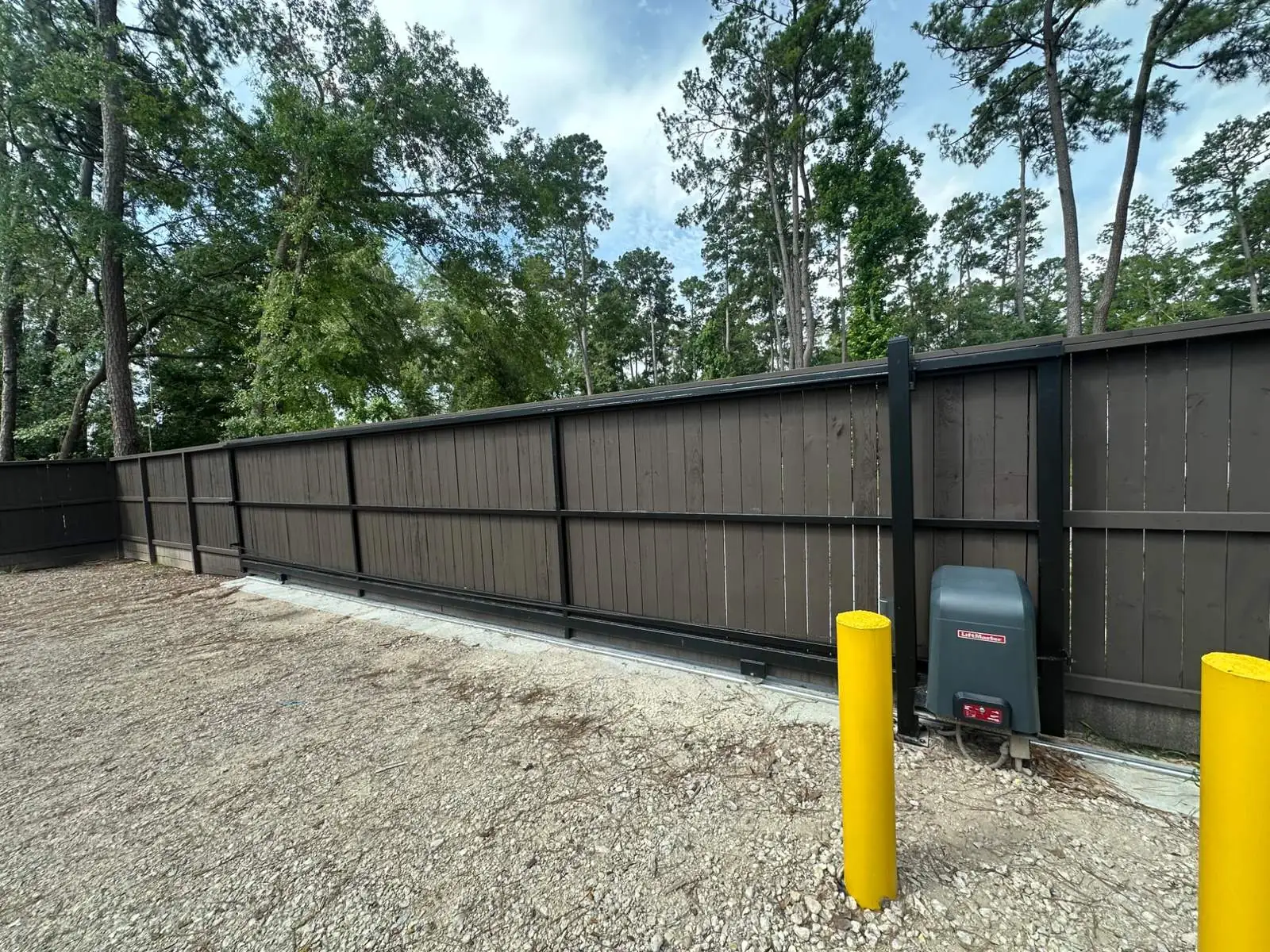
Residential gate decisions are mostly about looks and budget. Commercial decisions are about throughput, cycle life, liability, and what happens at 6am when a truck is waiting and the gate will not open. Here are the gate types we install across Houston’s warehouses, apartment complexes, contractor yards, and industrial sites, and what each one is actually good at.
Rolling Slide Gates (V-Track)
The gate rides on wheels in a track set into the drive surface. Simple, well-proven, and the least expensive way to close a wide opening.
Good for: flat sites with a solid, level drive surface and openings up to about 40 feet.
Watch out for: the track. In Houston, a ground-level track collects mud, gravel, and leaf litter after every heavy rain, and a packed track is the single most common cause of a slide gate that stops moving or starts grinding. Sites that flood or that get heavy debris are better served by a cantilever.
Cantilever Slide Gates
The gate hangs from rollers on posts beside the opening and never touches the ground. There is no track across the drive.
Good for: anywhere debris, flooding, or heavy truck traffic would destroy a track. Also the right answer where the drive surface is uneven or where a track would be a trip or damage hazard.
Watch out for: the counterbalance. A cantilever needs a tail section roughly half the opening width running back along the fence line, so a 30-foot opening needs about 45 feet of clear run. If you do not have that space, the geometry does not work.
Commercial Swing Gates
Single or dual leaves on hinges, same as residential but built heavier.
Good for: narrower openings, sites with plenty of clearance inside the fence line, and entrances where appearance matters — office parks, apartment front entrances, gated communities.
Watch out for: wind and swing radius. A tall solid swing leaf on the Gulf Coast is a sail, and it needs a heavy frame, deep footings, and an operator sized accordingly. Dual swing also means two operators or a dual-arm setup, which is two more things to maintain.
Barrier Arms
A pivoting arm that lifts. Fast, simple, and built for high cycle counts.
Good for: parking control where you need to meter vehicles, not secure a perimeter — garages, employee lots, toll points. They cycle in a couple of seconds, which matters when 200 cars arrive between 7:30 and 8:00.
Watch out for: they stop cars, not people, and they are trivially defeated. Never treat a barrier arm as security.
Vertical Pivot and Vertical Lift
The gate rotates or lifts upward instead of sliding sideways.
Good for: sites with no room on either side for a slide gate to travel, and sloped entrances where a swing leaf would hit the ground. Vertical lift also suits high-security sites because there is no track to jam and the gate can be built very heavy.
Watch out for: overhead clearance and the heavier operator these require. Also power lines, which are a real constraint on a lot of older Houston industrial sites.
Operator Class Is Not Optional
Gate operators are rated by use class under UL 325 — Class I residential, Class II general access like apartments and retail, Class III industrial and limited access, Class IV restricted and supervised. Putting a residential-class operator on an apartment entrance is a common shortcut that fails on both counts: it burns out fast under the cycle load, and it is not the equipment the standard calls for on a property the public uses. Our gate safety guide covers what each class requires.
Cycle count is the number to give your installer. A ten-unit contractor yard might see 40 cycles a day; an apartment complex entrance can see 800. That number, plus gate weight and width, is what sizes the operator.
Access Control for Commercial Sites
The residential options — remotes, keypads, phone apps — still apply, but commercial sites usually need more:
- Telephone entry / directory systems for apartments and offices, so visitors can call a unit and be buzzed in.
- Card and fob readers where you need per-person credentials that can be revoked when someone leaves.
- License plate recognition for high-throughput sites with a known vehicle list.
- Loop detectors for exit and safety loops so vehicles trigger the gate automatically.
- Cloud management so a property manager can issue and revoke codes remotely and pull an access log.
The access control guide compares the underlying technologies.
Fire Department and Emergency Access
This one gets missed and then gets caught at inspection. Houston-area fire departments require emergency access to gated properties, typically via a Knox box containing a key or a switch, and often a separate override. Get the requirement from your local jurisdiction before the gate is designed, not after — retrofitting emergency access into a finished install is more disruptive than building it in.
Uptime Is the Real Spec
On a commercial site the question is not whether the gate will fail but how often and for how long. Three things drive that:
- Correct sizing. An operator running near its limit every cycle fails early. One with headroom lasts.
- Scheduled maintenance. High-cycle gates need quarterly service, not annual. What that visit should cover is in the commercial maintenance guide.
- Protecting the hardware. Bollards at the operator and the gate ends, because on a site with trucks and trailers, the gate will eventually get hit.
Picking the Type in One Pass
- Wide opening, flat, clean surface, room to one side → rolling slide
- Wide opening, debris or flooding, truck traffic → cantilever slide
- Narrower opening, appearance matters, room inside → swing
- High vehicle volume, no perimeter security needed → barrier arm
- No side room or a sloped entrance → vertical pivot or lift
Sized to your cycle count, built to keep the site moving
Installation, access control, emergency access, and scheduled service for warehouses, apartments, yards, and industrial sites across Greater Houston. More on our commercial gate services page.