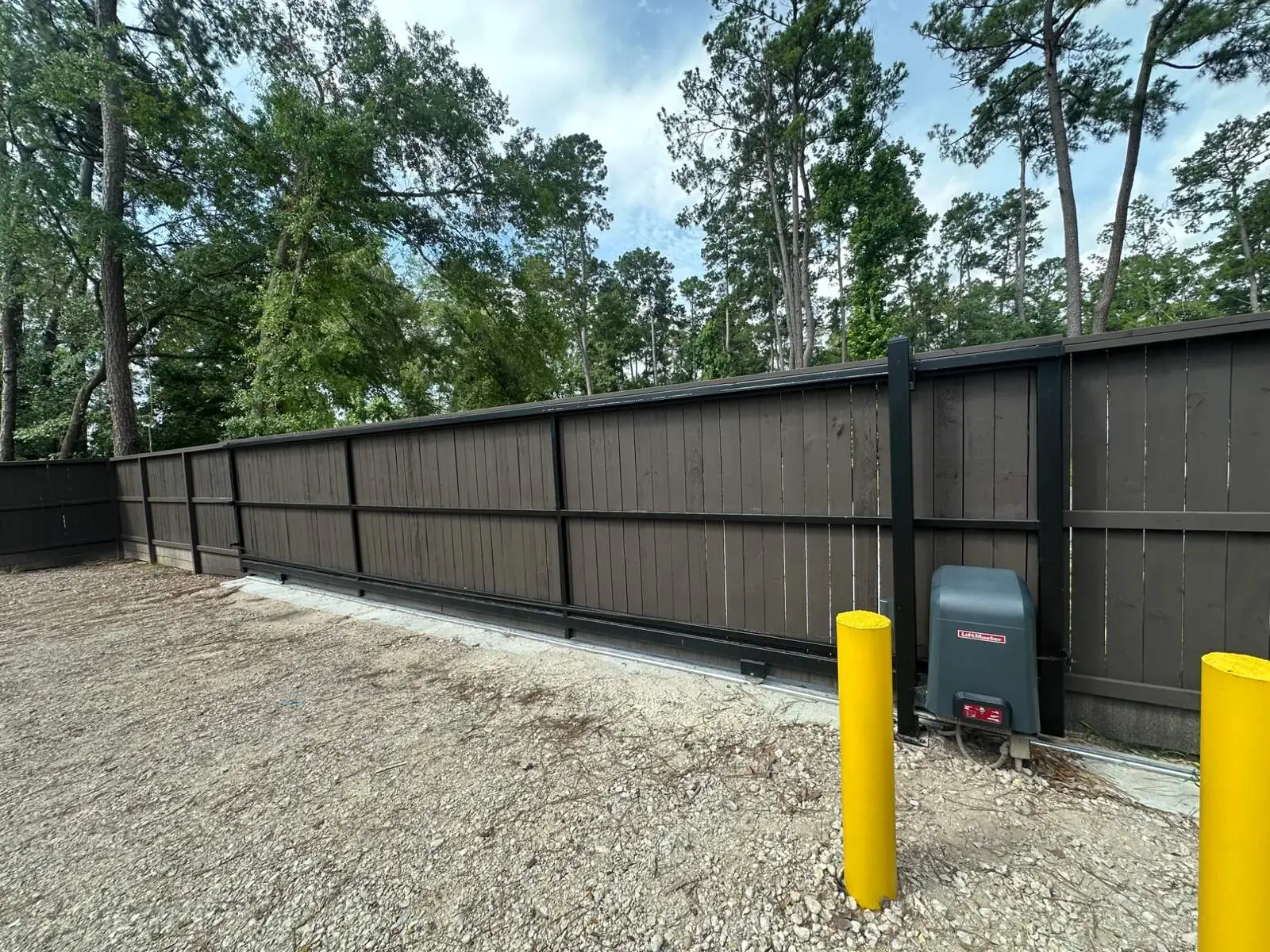
A gate motor that hums without moving is receiving power but cannot turn. In practice that means one of four things: a failed start capacitor, a mechanically seized gate or gearbox, a broken or disengaged drive component, or a motor that has failed internally. The hum itself is important — it confirms the electrical supply and control board are working.
What the Hum Actually Tells You
The hum is the sound of energized motor windings that are not producing rotation.
That is genuinely useful. It means the breaker is on, the transformer is working, the control board received your command and closed the relay, and voltage reached the motor. Everything upstream of the motor is functioning.
So you can stop checking remotes, receivers, photo eyes, and breakers. The fault is at the motor or beyond it.
1. Failed Start Capacitor
This is the most common cause by a wide margin.
Single-phase AC motors cannot start themselves. They need a capacitor to create a phase shift that gets rotation going. Once spinning, the motor sustains itself — but without that initial kick it sits there energized and humming, drawing heavy current and heating up.
Capacitors are a wear item and they fail predictably. Heat shortens their life considerably, and gate operators in this region sit in direct sun inside enclosures that get very hot. A capacitor rated for years in a temperate climate can fail substantially sooner on a Houston driveway.
- Loud hum, no movement, in both directions
- Motor gets hot quickly if power is left applied
- The gate sometimes starts if given a nudge by hand — this is close to diagnostic
- The failure appeared suddenly rather than gradually
- A visible bulge, split, or leaked residue on the capacitor body
A serious safety note: capacitors store electrical charge and hold it after power is disconnected. The charge in a motor start capacitor is enough to cause a significant shock and, in the wrong circumstances, worse. They must be discharged properly before handling. This is not a component to poke at with a screwdriver based on a video.
2. Mechanically Seized Gate
If the gate physically cannot move, the motor hums against a load it cannot overcome.
- Frozen or seized hinges on a swing gate, from rust or failed bushings
- Seized rollers on a slide gate
- Track completely blocked by debris, a wedged rock, or a fire ant mound
- Gate jammed against something — a vehicle parked too close, a fallen limb, accumulated mulch
- Ground movement shifting a post enough that the gate binds against the strike or catches on the driveway
- A gate that has dropped on failed hardware and is now resting on the ground
The test: kill the power, release the operator manual disconnect, and try to move the gate by hand. If it will not move, the problem is mechanical and the motor is innocent. If it moves freely, the motor or its drive train is at fault.
Every gate operator has a manual release, usually a lever or key-operated disconnect on the housing. Knowing where yours is before you need it is worth five minutes.
3. Broken or Disengaged Drive Components
The motor may be turning something that is no longer connected to the gate.
- Sheared drive key or pin. A small, cheap part that fails and disconnects motor from gearbox.
- Broken chain on chain-drive slide operators.
- Stripped gearbox gears. Nylon gears in some designs strip under sustained overload — often the endpoint of running a gate that has been dragging or grinding for months.
- Disengaged manual release. If someone released the operator to move the gate by hand and never re-engaged it, the motor runs happily and the gate does not move.
That last one is worth checking early, because it is free to fix and more common than you would think — particularly after a power outage, a party, or any situation where someone needed the gate open in a hurry.
Note that a fully disengaged drive often produces a normal-sounding motor rather than a strained hum, since the motor is spinning under no load. A strained hum with heat points more toward capacitor failure or seizure.
4. Motor Failure
Less common, but real. Internal winding failure, shorted windings, or seized motor bearings all present as a hum without rotation.
Water intrusion into the motor housing is a frequent precursor — operators with cracked housings or failed gaskets take on water during storms, and corrosion follows. Gulf Coast humidity accelerates this considerably compared to drier climates.
Motor failure is often the result of one of the other causes rather than an independent event. A gate left humming against a seized mechanism, or running with a failed capacitor, can burn out its windings in fairly short order.
Turn It Off
This is the one symptom on our troubleshooting list where continuing to try is actively harmful.
A motor humming under stall condition draws far more current than normal operation and converts nearly all of it into heat. Repeated attempts cook the windings, and can turn a straightforward capacitor replacement into a full operator replacement.
Some operators have thermal protection that cuts out to prevent this. Many older units do not, or the protection has already failed.
If your gate motor is humming and not moving: stop pressing the button, kill the power at the breaker, use the manual release to secure the gate in the position you need, and get it looked at.
What Is Safe to Do Yourself
Reasonable: turning off the breaker, locating and using the manual release, checking whether the release was left disengaged, clearing visible debris, and checking whether the gate moves by hand.
Not reasonable: opening the operator housing to inspect or replace a capacitor. The stored charge is a genuine hazard, and correctly identifying a replacement requires matching capacitance and voltage ratings.
A humming motor is usually a repairable fault caught early and an operator replacement caught late. The difference is often just how many times someone pressed the button hoping it would catch. Our guide to the warning signs of a failing gate opener covers what typically comes before this point.
We service gate operators throughout the north corridor, including Conroe, Willis, Montgomery, and Spring.
Stop pressing the button — every attempt makes it worse
We call back within 30 minutes. Same-day service available across Houston, The Woodlands, Conroe, Spring, and surrounding areas.