Most people have never had a gate installed and have no idea what they are agreeing to. Does someone dig up the driveway? How long is the opening unsecured? Who handles the electrical? Here is the whole process, honestly, including the parts that take longer than customers expect.
Step 1 — The Call and the Site Visit (Day 1–3)
You call, we call back within 30 minutes, and we schedule a site visit. The owner comes out personally — this is not a salesperson with a tablet. The visit takes 30 to 45 minutes and we are measuring and assessing specific things: driveway width, slope, and where vehicles actually stop; swing clearance or run-off space for a slide; soil and drainage conditions at the post locations; distance to the nearest power source; and any HOA or deed restriction that applies to your address.
You get a written, itemized quote — gate, operator model, access control, site work — either on the spot or within 24 hours. Itemized matters because it is the only way to compare bids honestly.
Step 2 — Design and HOA Approval (Day 3 to Week 6)
This is the phase that varies most. If you are not in a deed-restricted community, we move straight to fabrication. If you are, we prepare the submission package — dimensioned drawings, site plan, material and finish specs — and your HOA architectural committee reviews it. Most Houston-area ARCs meet monthly and quote 30 days.
Practical advice: this step, not fabrication, is usually the long pole. Start it early. We time the shop work so your gate is ready right as approval lands rather than sitting finished in our shop for three weeks.
Step 3 — Fabrication (1–2 Weeks)
Your gate gets built in our shop. Cut, welded, ground, prepped, and finished. Custom work — arches, scrollwork, matching an existing fence profile — sits at the longer end. Nothing happens at your property during this phase, and your driveway is untouched and fully usable.
Step 4 — Installation Day One: Posts and Power
This is the disruptive day, and it is worth knowing what it looks like. We call 811 beforehand so underground utilities are marked. Then we excavate for the post footings — these are deeper and wider than fence post holes because Houston clay demands it and because a gate post carries the leaf as a lever.
If power needs to reach the gate, we trench conduit from your panel on this day too. On long runs across a lawn this is the messiest part of the project. We backfill and restore as we go, but expect disturbed ground along the trench line that will need a few weeks of watering to blend back in.
Then the concrete goes in — and this is the part customers most often want to rush. Footings need to cure before they carry a gate. We typically allow a full cure period before hanging any weight. Skipping this is exactly how posts end up leaning within a year, and no amount of later adjustment fixes a footing that was loaded green.
Step 5 — Installation Day Two: Hanging and Automating
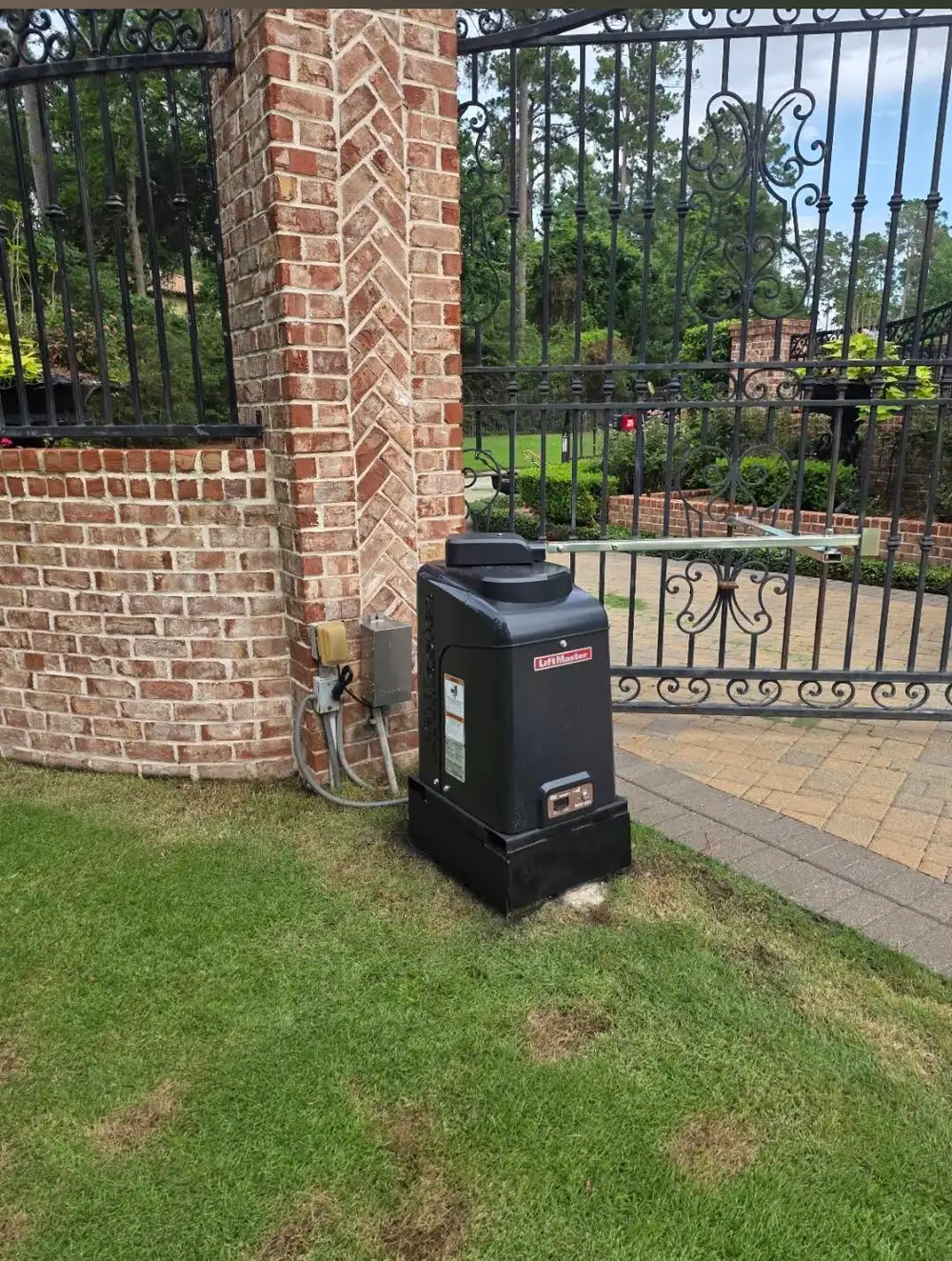
The gate gets hung, leveled, and adjusted. Then the operator goes on its pad, gets wired, and the safety equipment goes in — photo-eye entrapment sensors on both sides, and a vehicle detection loop if the application needs one.
Programming follows: travel limits set so the gate stops exactly where it should, force settings calibrated so the gate reverses on contact at the levels safety standards require, remotes paired, keypad codes loaded, and CellGate or myQ configured if you chose them.
Step 6 — The Walkthrough
Before we leave, we run the gate through full cycles with you watching and cover four things: how to work the manual release (rehearse it — this is what you will need during a hurricane outage), how to add and delete keypad codes yourself, what routine maintenance looks like and when, and exactly what your warranty covers. You get the paperwork and the manufacturer documentation.
Realistic Total Timeline
- No HOA approval needed: roughly 2–3 weeks from quote approval to working gate
- With HOA approval: roughly 5–8 weeks, driven almost entirely by the committee calendar
- Days your driveway is actually affected: two, and it stays usable between them
- Days your driveway is fully blocked: none — we sequence so you can get in and out
What Slows Projects Down
In order of frequency: HOA review cycles, weather (we do not pour footings into standing water — Houston spring rain moves schedules), utility marking delays, and customers changing the design after fabrication has started. The last one is avoidable and expensive, which is why we push for design decisions to be final before the shop cuts anything.
Free site visit — the owner comes out personally
We call back within 30 minutes. Same-day service available across Houston, The Woodlands, Katy, Spring, and surrounding areas.