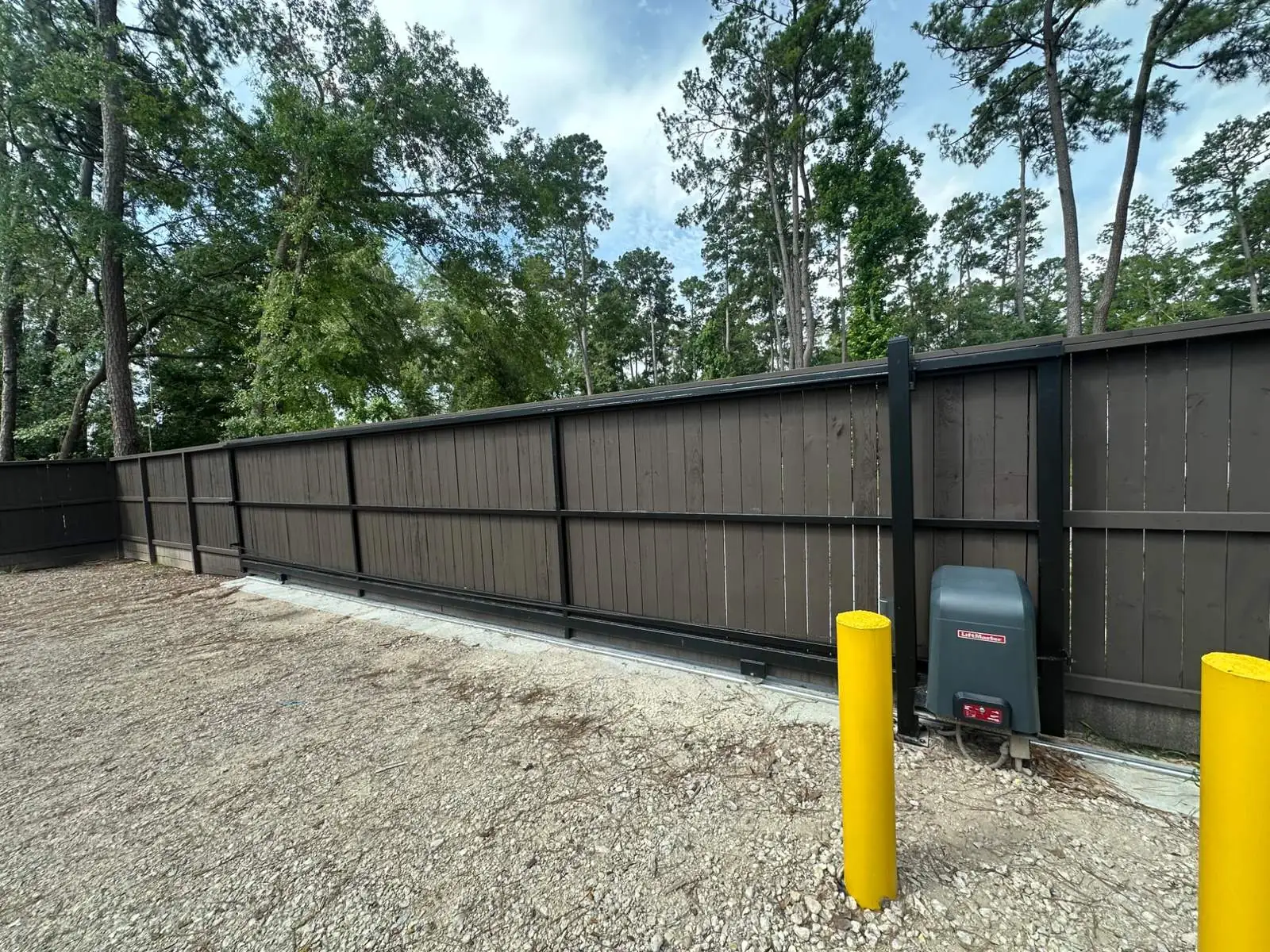
A residential gate cycles maybe fifteen times a day. An apartment complex gate can cycle four hundred. That single number drives every decision that matters on a commercial property, and it is why residential-grade thinking fails so expensively in commercial applications.
Duty Cycle Is the Whole Ballgame
Duty cycle is the rating that says how much a gate operator can work without overheating or wearing prematurely. Residential operators are built for light intermittent use. Commercial operators are built to run continuously.
When a contractor installs a residential-grade operator on a 300-cycle-a-day property because it was cheaper, the unit does not fail dramatically on day one. It works fine for a year. Then it starts running hot, the gear wear accelerates, and somewhere in year two or three it dies — usually on a Friday afternoon with tenants blocked out. We are called in to replace undersized operators on Houston commercial properties constantly, and the replacement always costs more than the right unit would have cost originally.
For genuinely high-cycle applications we spec Viking PT-series or LiftMaster's commercial line, sized with real headroom above the actual measured cycle count — not the count somebody estimated during the bid.
What Downtime Actually Costs You
The repair invoice is the smallest number in a gate failure. The real costs land elsewhere: tenants who cannot get in and are now calling the office, a leasing tour that walks up to a broken entrance, an open perimeter overnight on a storage facility, and the liability exposure of a gate propped open or stuck in an unsafe position. Multiply that across a two-day parts wait and the math on paying for a correctly sized operator stops being close.
Access Control for Multi-Tenant Properties
Residential access control is about you and your guests. Commercial access control is about credential management at scale, and the requirements are different:
- Telephone entry with a directory (DoorKing 1802/1812 class) — visitors find a tenant, call, and get buzzed in. Standard for apartments and offices.
- Per-tenant credentials — individual codes or fobs so access can be revoked at move-out without reprogramming the property. Shared codes are the number one security failure at multi-tenant properties.
- Audit logging — who entered, when. Essential for storage facilities and for resolving disputes.
- Vehicle detection loops — properly installed and calibrated so the gate does not close on a trailing vehicle, and free-exit works reliably.
- Emergency access — Knox box or approved override so fire and EMS get through. Local fire code requirements apply and inspectors do check.
The Failures We See Most on Commercial Properties
- Undersized operator on a high-cycle gate — covered above, and it is the leading cause by a wide margin
- Slide gate track debris — commercial driveways collect rocks, gravel, and trash; a fouled track binds the gate and the operator fights it until something gives
- Loop detector failures — pavement cracks cut loop wire; the gate stops detecting vehicles and either will not open or closes on cars
- Impact damage — delivery trucks hit commercial gates regularly, and a bent leaf throws off alignment the operator then strains against
- Deferred maintenance compounding — a property with no service contract typically only calls when the gate is fully dead, which means everything upstream of the failure is also worn
Why Maintenance Contracts Pay on Commercial Properties
Residential owners can reasonably run on an annual check. Commercial properties should not. Quarterly service on a high-cycle gate catches roller wear, track alignment, loop integrity, hinge condition, and force calibration before any of them become an outage.
The business case is straightforward: scheduled maintenance is a predictable line item you can budget. Emergency replacement is an unpredictable one that arrives at the worst time, usually with tenant complaints attached. For properties where gate uptime affects tenant satisfaction or security obligations, the contract is cheaper than the alternative over any reasonable horizon.
Safety and Liability on Public-Facing Gates
A commercial gate serves the public, which raises the liability stakes considerably compared to a residential driveway. Entrapment protection in both directions, correctly calibrated force settings, required signage, separated pedestrian access, and guarding on moving hardware are all part of the recognized standard of care. On a property you manage for an owner, a non-compliant gate is exposure you are carrying on their behalf. It is worth knowing the condition of every gate in your portfolio rather than finding out after an incident.
What We Do for Houston Commercial Properties
We install and service commercial gate systems across the Houston metro — the US-290 and FM 1960 corridors, the Energy Corridor campuses, Stafford and Rosenberg industrial, and apartment and storage properties throughout. That includes new installation, operator replacement and right-sizing, DoorKing and access control work, loop detection, and scheduled maintenance contracts.
If you manage multiple properties, we can walk the portfolio and give you a written condition report on each gate — what is undersized, what is out of compliance, and what is going to fail next — so you are budgeting from facts rather than reacting to failures.
We will assess your portfolio and give you a written condition report
We call back within 30 minutes. Same-day service available across Houston, The Woodlands, Katy, Spring, and surrounding areas.