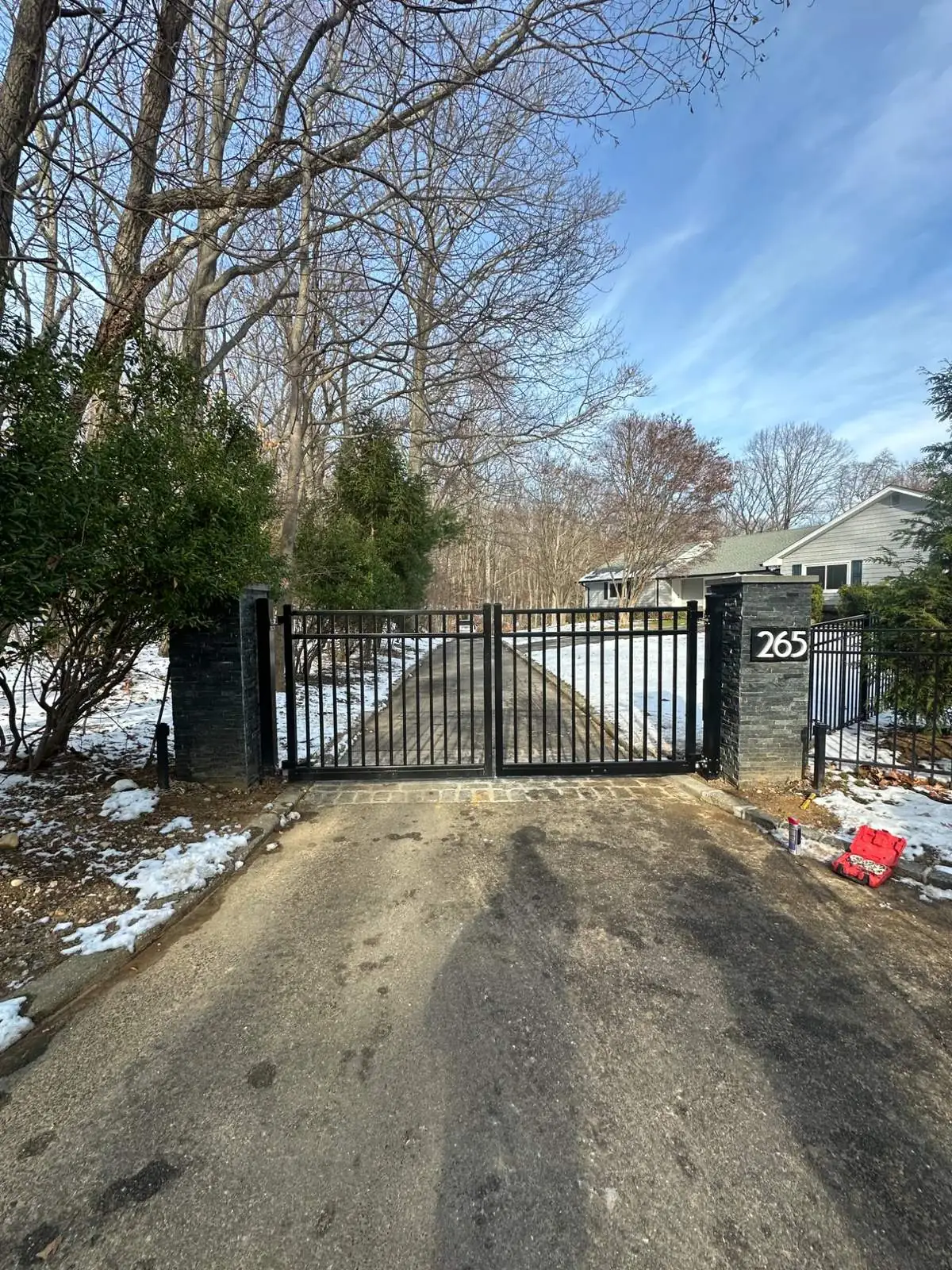
A suburban gate moves a 12-foot leaf across smooth concrete with power ten feet away. A ranch gate spans 20 feet over caliche, gets hit by trailers, sits a quarter mile from the nearest outlet, and has to keep livestock in. Same trade, different engineering. Here is what acreage properties actually need.
Width Is the First Constraint
Suburban gates are sized to cars. Ranch gates have to pass gooseneck trailers, hay equipment, feed trucks, and the occasional contractor with a wide load. Sixteen feet is a practical minimum on a working property; twenty is common and rarely regretted.
Width changes everything downstream. A 20-foot opening as a dual swing means two 10-foot leaves, each acting as a long lever on its post — which drives footing size and hinge spec. As a single slide it means 20 feet of run-off space along the fence line plus a heavier operator. We work through this tradeoff on every acreage quote, and the answer usually comes down to whether you have the run-off room and whether your approach slopes.
Unpaved Approaches
Caliche, gravel, and dirt driveways rule out some designs outright. A ground-track slide gate on gravel is a service call waiting to happen — rocks and mud pack the track and the gate binds within a season.
Two solutions work here. A cantilever slide carries the gate on overhead rollers with no ground track at all, which is our usual recommendation for gravel. Or a swing gate, which does not care what the surface is as long as the approach is level enough for the leaf to clear. Swing gates on unpaved drives do need attention to grade — a driveway that rises toward the gate will catch the leaf.
Power, and the Absence of It
The defining acreage problem. The right gate location is frequently hundreds of feet from the nearest power source, and trenching conduit that distance gets expensive fast — on a long run the electrical work can exceed the cost of the gate itself.
Solar is usually the answer past about 100 feet, and Texas sun makes it genuinely reliable when sized honestly. The failures come from undersized panels and batteries, not from solar as a concept. The math that matters is daily cycle count against battery capacity and panel wattage — a family plus ranch hands plus deliveries can run 30 cycles a day, and a starter kit will not keep up through a cloudy week.
One acreage-specific wrinkle: panels need real sun. Wooded properties in Magnolia and Tomball often need the panel mounted well away from the gate to find a clear southern exposure. We run that cable when the site calls for it.
Livestock Changes the Requirements
If you run cattle, horses, or goats, the gate is part of your fence, not just your entrance:
- Gap discipline. Bottom clearance and picket spacing sized for your smallest animal. Goats in particular will find any gap you leave.
- Auto-close is not optional. A timer that closes the gate behind every vehicle prevents the expensive kind of mistake. We set this on essentially every livestock property.
- Cattle guards. Where a guard sits in the opening, gate placement and operator location have to work around it.
- Animal-proof the hardware. Livestock rub on anything at scratching height. Operators and wiring need guarding or placement out of reach.
Operator Sizing for Real Ranch Gates
This is where we see the most failures on rural properties. A 20-foot pipe gate is heavy, and a residential operator rated for a light suburban leaf will run at the edge of its capacity on every cycle and burn out in two or three years. We spec commercial-grade Viking or LiftMaster units sized with headroom above the actual gate weight — not the optimistic weight, the real one including any center panel or screening.
Wind is the second load nobody accounts for. Open country means gusts push directly on the gate face, and a screened or solid gate catches significantly more. Operator and hinge sizing should account for it.
Impact Damage Is a When, Not an If
Working properties bump their gates. A trailer swings wide, a delivery truck misjudges the opening, a tractor clips a post. Two things reduce the pain: building the gate heavy enough that a bump bends nothing structural, and setting posts with footings that do not shift when something hits them. We also recommend leaving the approach wider than feels necessary — the cheapest impact protection is room to maneuver.
Where We Work
We install acreage and ranch gates throughout the rural corridors around Houston — Magnolia, Tomball, Waller, Hockley, Montgomery, Willis, New Caney, Alvin, and the Brazoria County properties south of Manvel. Long drives are normal for us and the 30-minute callback holds regardless of how far out you are.
Free site visit — we price solar and wired side by side
We call back within 30 minutes. Same-day service available across Houston, The Woodlands, Katy, Spring, and surrounding areas.